Welcome Satori - the new fNIRS analysis software from Brain Innovation

Written by Dr. Michael Lührs of Brain Innovation B.V.
We are very happy to present to you the first version of Satori, an analysis software for functional near-infrared spectroscopy (fNIRS) data. Whereas Turbo-Satori, the previous release from Brain Innovation, is designed and optimized for real-time applications such as neurofeedback and brain-computer interface (BCI), Satori aims directly at offline analysis.
It is specifically designed to integrate easily with your research while providing state of the art processing and analysis pipelines.
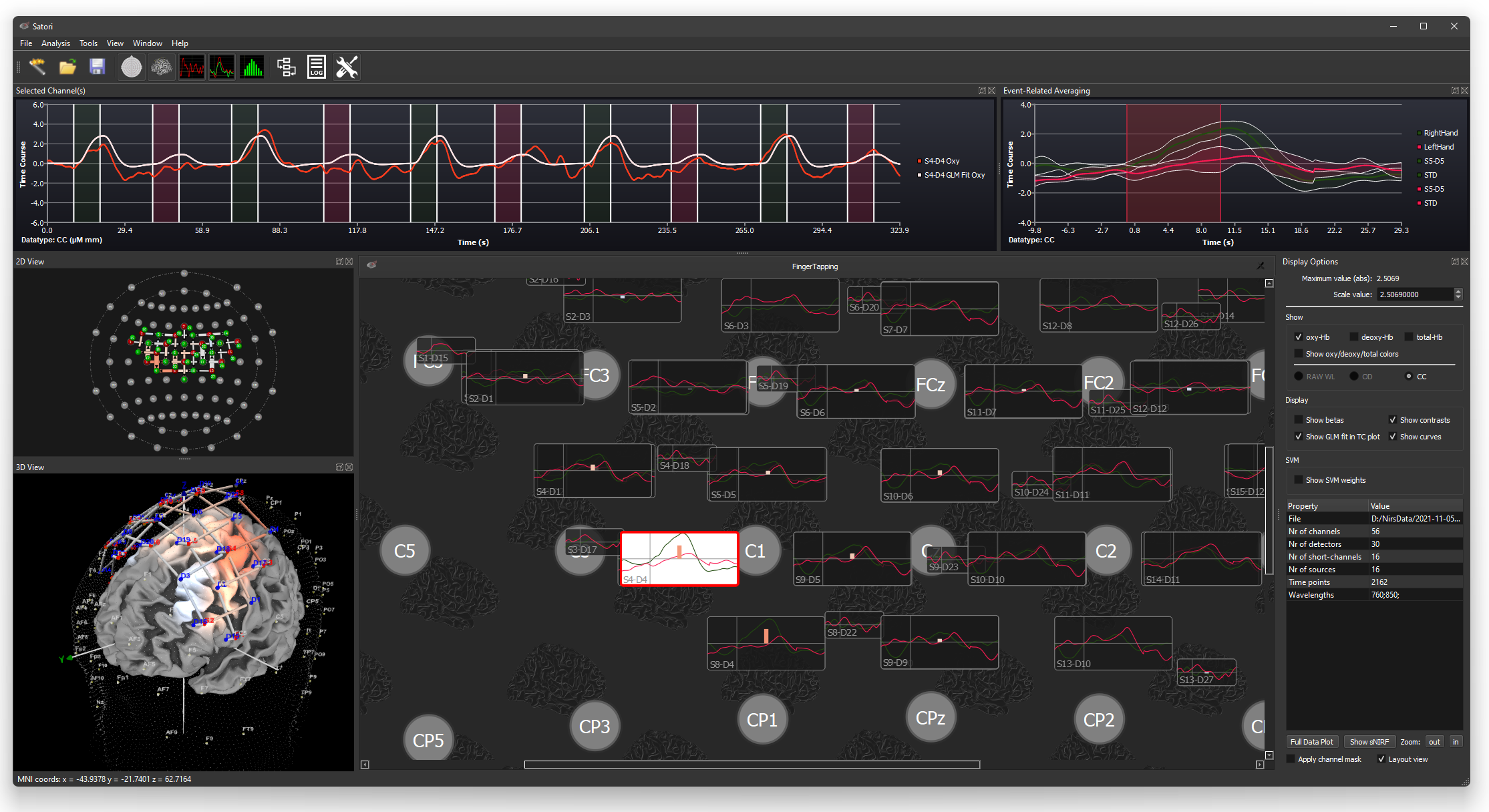
Satori was first developed as an in-house project to easily preprocess and analyze our own fNIRS data. We quickly realized its potential and are now very happy to be able to make it available for everyone.The usability of the software is thereby one of Satori’s highlights. The fNIRS data can be inspected at any time and visualized in different forms and layouts. Please take a look at the shot below for a first glimpse of Satori.
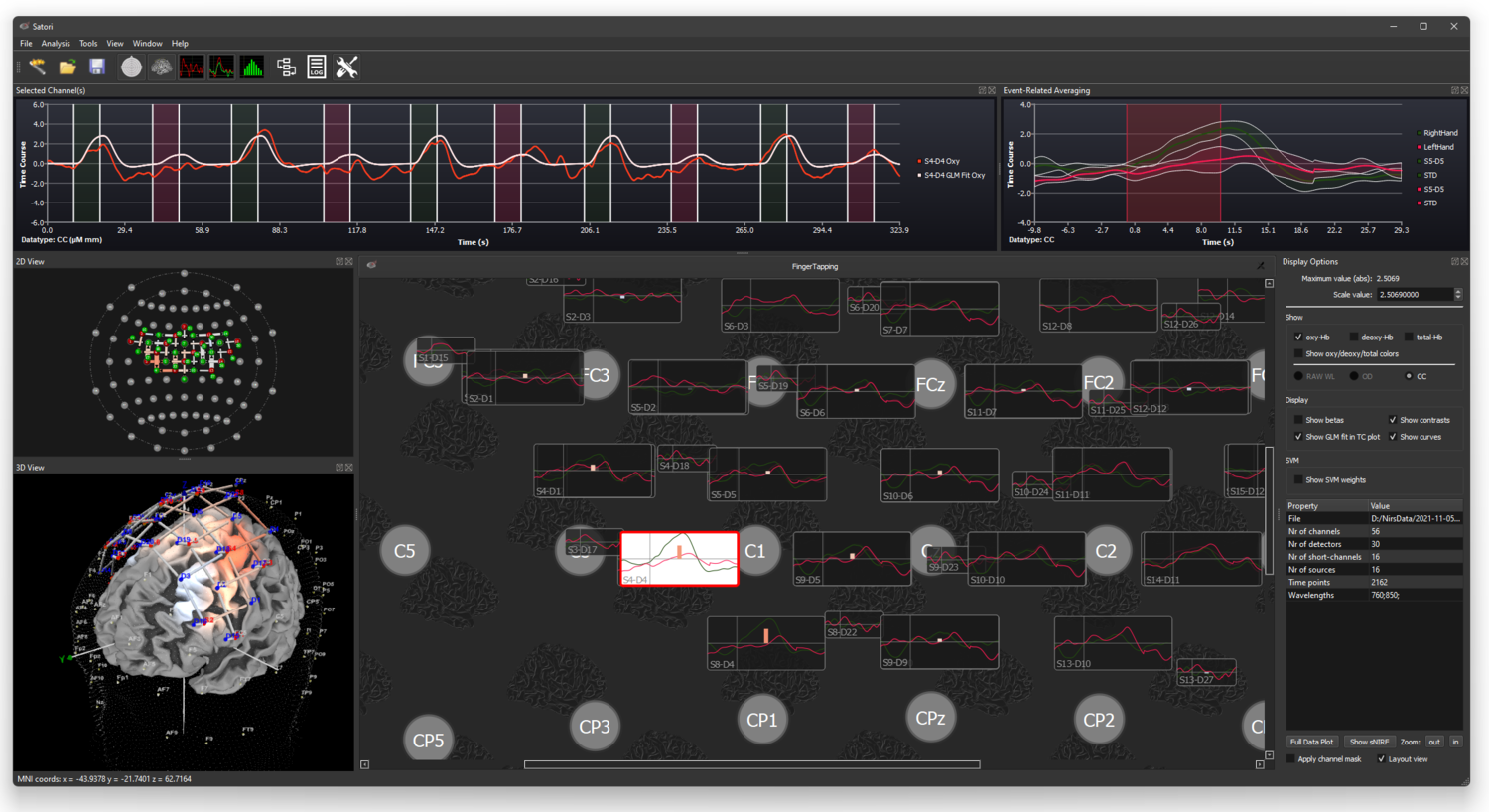
Having the possibility to inspect multiple views of the data at the same time allows for a much better orientation of the location of specific brain activity. In the example above, you can clearly see more activity on the left hemisphere induced by right-hand finger tapping.
Of course, the windows to inspect the data can be freely arranged and detached from the main window. This allows for a more detailed view as you can see below.

The time course of individual channels can be inspected for the different chromophores (Oxy, DeOxy and Total Hemoglobin). This includes the simultaneous view of event related averages and the whole channel time course. The versatility of Satori allows you to quickly review and understand the fNIRS data before deciding on the most suitable preprocessing and analysis method.
The launch of this first version promises continuous developments, support, and education to make fNIRS more accessible to researchers in the years to come. Stay tuned for future updates of Satori which will include direct access to Python, further developments for the Flow manager (a tool to organize and streamline your preprocessing and analysis).
We are looking forward to an exciting journey together with you!
New Software Updates Aurora + NIRSite
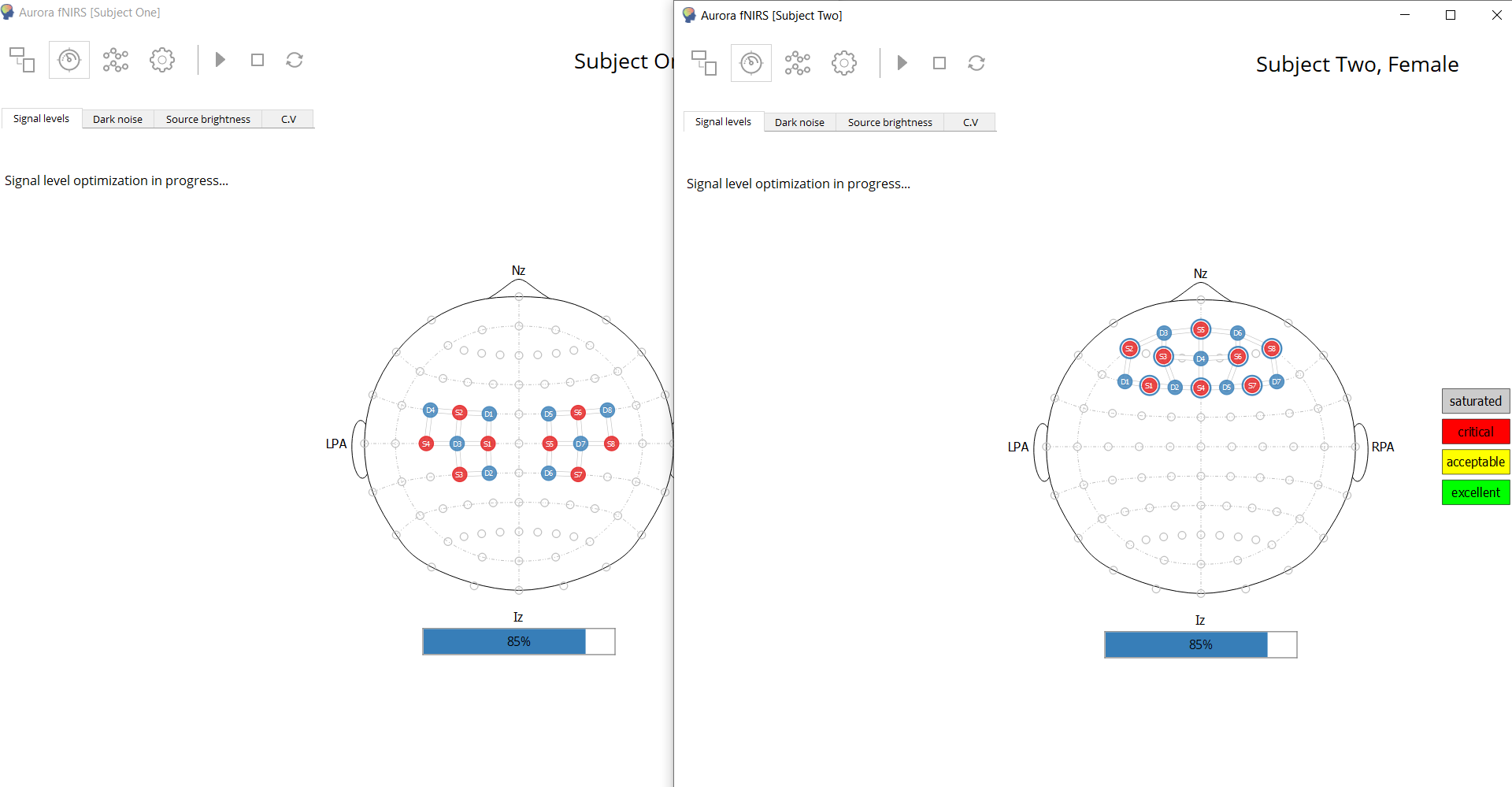
We are delighted to announce new software versions for Aurora and NIRSite by NIRx. They may already be downloaded from our Help Center!
We are delighted to announce new software versions for Aurora and NIRSite by NIRx. They may already be downloaded from our Help Center! These updates include compatibility for MacOS and the Hyperscan application. Thank you to our team in Berlin for making this happen.

Aurora 2021.4: Data acquisition with NIRSport2
New features and improvements
Support of single device split Hyperscanning in Hyperscan application. Ability to choose two different (max. 8x8) configurations to run from one NSP2 device, support for short channels and accelerometer. Independent visualization of data, separate storage of data.
LSL stream update: Inclusion of subject information (name, age, etc.) in LSL stream metadata.
Full accelerometer data in LSL stream.
Full accelerometer data (100 Hz) in SNIRF file.
Accelerometer samples (in LSL stream, *.acc, and SNIRF file) are corrected for drift of clock between NSP2 and accelerometer.
More default montages & configurations included when Aurora is initially installed.
Bug fixes and changes
Better error messages/handling when writing access to Documents folder is denied by Windows
Validation of "Data root directory" and "Configuration directory" on the settings page (i.e. errors when the directory does not exist or Aurora can't write to it)
Hyperscan data now saved in the Hyperscan folder instead of the Data folder.
Better validation of custom channel names/labels

NIRSite 2021.4: Montage Creation
Bug fixes and changes
Compatibility now spans from macOS Mojave to Big Sur.
Optode positions created in the fNIRS Optodes’ Location Decider (fOLD) can be loaded directly into NIRSite (if saved in ASCII format).
Digpts.txt file is automatically generated in the montage folder.

Additionally, we will be hosting an open webinar 11th May, 10 am EST/ 4 pm CET on Hyperscan: The hyperscanning feature for NIRSport2 + Aurora that will go over many of these features - see you there!
Would you like to learn more? Feel free to reach out to our support team. We’d be happy to hear from you.
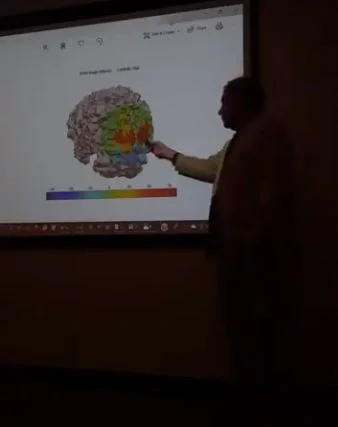
fMRI and fNIRS: Comparative Paradigms
Summary of the Houston Workshop: fMRI and fNIRS: Comparative Paradigms, with Dr. Tom Zeffiro of the Baltimore VA
General Summary

Recently, NIRx Medical Technologies hosted a workshop at The University of Houston with guest speaker and fMRI expert, Dr. Tom Zeffiro.
Dr. Zeffiro has now worked in fMRI for several decades and has now worked in the field of fNIRS for sometime as well. Due to the increased popularity of the modality, Dr. Zeffiro has decided to transition his passion and related knowledge of fMRI into the field of fNIRS. This combination of modalities is near perfect as the BOLD signal of fMRI is so highly related with the hemodynamic response of fNIRS.
The purpose of this workshop was to build on and apply the current knowledge of fMRI into the field of fNIRS to create a useable and understandable methodology for any fNIRS user. There are several reasons why this purpose would useful for fNIRS users.
The first reason is simply due to the larger number of publications in fMRI that are completely (or at least near-completely) translatable into the realm of fNIRS. This allows fNIRS users a wider range of documentation and resources when conducting their experiments, and creates a valuable repository to help answer questions that arise when current fNIRS repositories fall short.
Additionally, this purpose also aimed to build on the often more established topics in fMRI and translate the information to the fresher realm of fNIRS. This would enable researchers who might be currently familiar to fMRI but perhaps new to fNIRS to gain a more stable first footing into the field.
The workshop was split into a 2-day program covering the basics of fMRI experimentation, signal processing, and analysis through to the translation of these topics into fNIRS. The talk focused on similarities, incongruencies, and applications in both technologies.
Day 1

Dr. Zeffiro began the workshop spanning the breadth of fMRI. This included a broad overview of the technology, sparing the crowd from many of the intrinsically deep details.
During the day, the conversation never touched heavily on any specific application, nor did it demonstrate any real analysis, but during the conversation, Dr. Zeffiro did share anecdotes about popular studies in the field. The day focused on introducing the attendees to the fabric of fMRI, ensuring an all-encompassing overview of the field. While initially a bit overwhelming in information, Dr. Zeffiro proved his experience in delivering these workshops on day 2, when the course came full circle tying in each concept introduced during day 1 to its application and reason.
Day 2
Entering day 2, Dr. Zeffiro clearly had a method to his madness as he calmly and astutely began to connect each of the dots presented in the previous day’s talk. There was clear relief and several “a-ha’s’ being exuded from the crowd as each audience member found moments of genius in the unsuspecting plan.
fNIRS came to the forefront of day 2 with fMRI simply adding the support beams to the explanations of the technology. Applications and technical acuity began to seep more and more into the conversations. Lending a more hands-on feel, without Dr. Zeffiro having to provide individual guidance.

Dr. Zeffiro’s opening topic, “what should you first do when you get a device?” started the day with curiousity and led the path of discussion all the way through analysis. The conversation led to the first experiment one should do with their system, enabling users to fully understand the technology, the device, the data, and the analysis.
Fingertapping enables the learning curve because it is such a simple task to understand, simple in its physicality, and simple in its cognitive load. The response to tapping fingers is large, and the response is quite intuitive to most brain scientists. The outcome should be a large response in the motor region. There may or may not find contra-laterality, but if all things are working properly, you absolutely will find a motor response, and therefore nearly guaranteed usable data to work with.
The day continued from this simple paradigm adding levels of complexity to the task. Showing the audience how one may alter the experimental question using simple steps, correcting the experimental paradigm, and eventually what accompanying analytical changes would be made to appropriately measure these more complex levels.
Each step was described in great and understandable detail. Many common processing and analysis steps were explained with the questions, “what”, “why”, and “how”.
In Closing
The workshop encompassed an enormous amount information during a two-day period, but brought a range of researchers into an environment focused on complicated topics in neuro-imaging while maintaining a focus on simplifying each topic to its bones.
The workshop enabled an open atmosphere for questions and discussion, and often detoured down the appropriate paths to ensure the audience was able to have all needed questions answered. Dr. Zeffiro was able to maintain this environment during both days while keeping his focus on the intended program.
We hope all attendees found use in their attendance, and we hope this summary does the workshop justice. If we happened to miss you for this first course, we look forward to seeing you in future courses!