Customized Caps & Probes
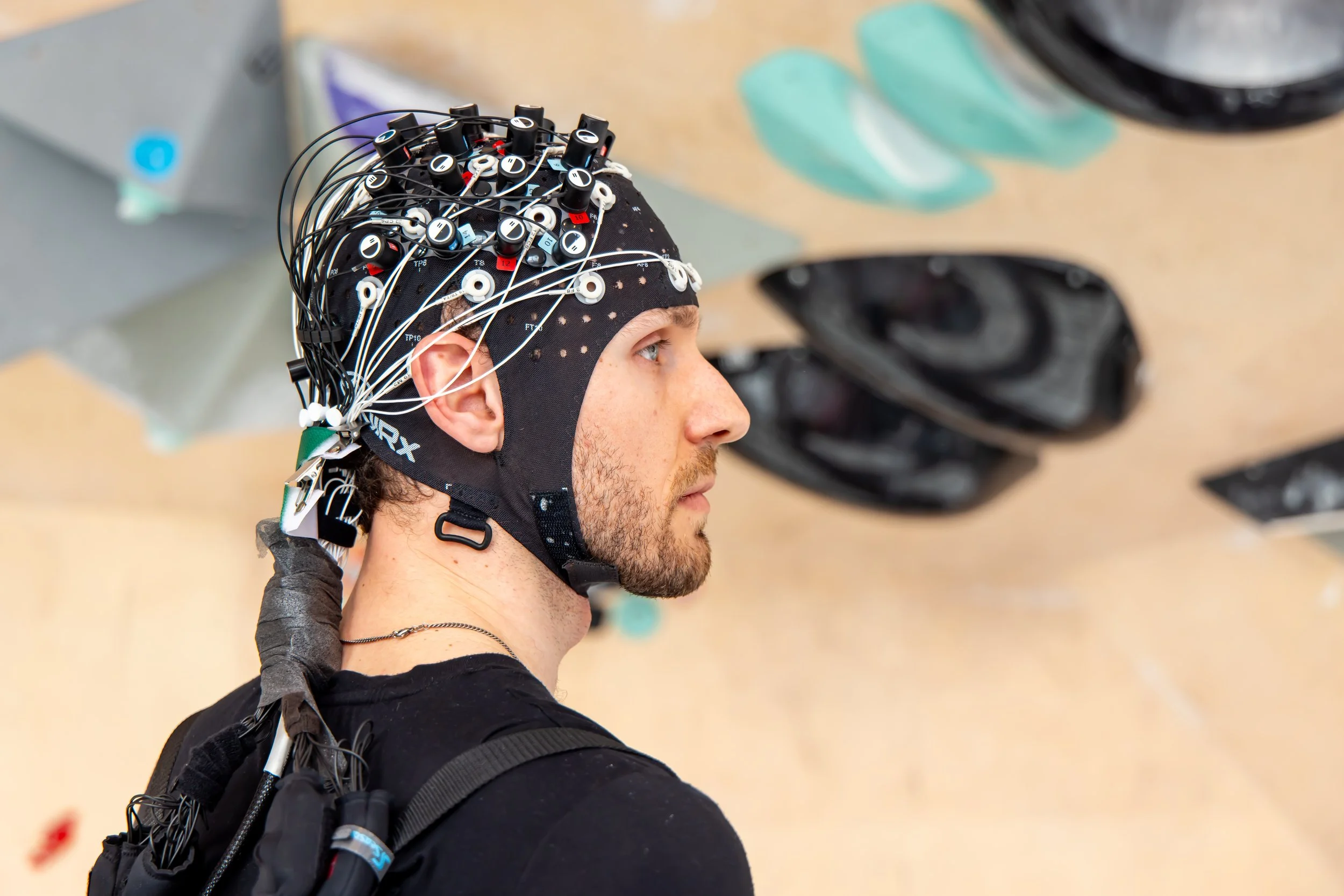
Probes and caps are crucial pieces of any NIRS system setup. Both you and your subject will be in intimate contact with these critical components every time the system is used.
NIRx offers complete flexibility for montage definition. The possibilities are nearly limitless. One may place probes on the 'standard' (e.g, 10-20, 10-10, 10-5) layout or in arbitrary positions; one may use multiple-distance measurements (tomography) or fixed-distance measurements (topography); one may have integrated EEG or other modalities (tDCS, accelerometer, etc.) in addition to NIRS, or simply use fNIRS alone on a dedicated NIRScap; and one may use fNIRS concurrently with fMRI, TMS, MEG, EKG, pulse oximetry, EMG, EOG, eye-tracking, motion-tracking, etc.
NIRS Regions of Interest
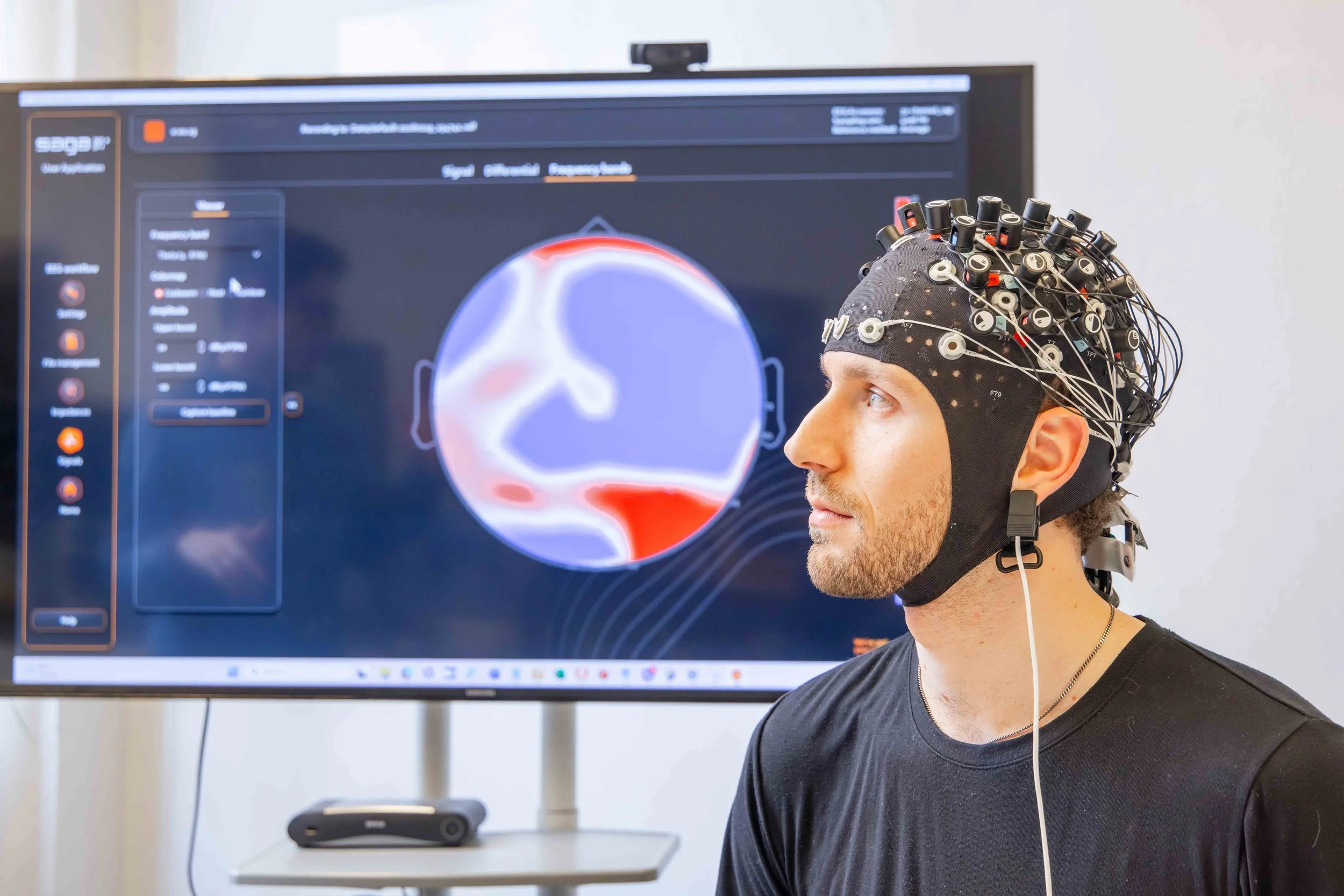
All NIRx systems allow for flexible placement of probes – data may be collected from any part of the head (actually, the probes can also be set up for peripheral fNIRS data collection as well). Here is just a sample of the areas one can easily measure with a NIRx fNIRS system:
fNIRS Brain Regions of Interest
- Pre-frontal cortex
- Dorsa-lateral pre-frontal cortex
- Supplementary motor area
- Premotor cortex
- Primary Motor cortex
- Somatosensory cortex
- Posterior parietal cortex
- Primary auditory cortex
- Broca's / Wernicke's area
- Primary visual cortex
- Others: contact NIRx
Contact us if you have questions on NIRScaps.
Standard vs. High-density NIRS Layouts
Probes may be placed on the standard EEG 10-10 layout positions with regular 3 cm distance, or in user-defined positions with multiple distances. In either case, it is vital to ensure controlled spacing between probes, as probe distance affects light penetration and signal quality. NIRx offers hardware and software solutions that help ensure precise spacing at the desired distances.
Standard fNIRS layout on EEG 128 positions

Right: A standard fNIRS montage with 16 sources and 16 detectors, arranged in 48 channels for motor measurements.
Sources are red, detectors are blue, and NIRS channels are purple.
This montage has 3 cm spacing between each optode.
NIRS topography
The montage to the right is a 'topographic' layout, with 3cm spacing between each probe.


High-density fNIRS layout for tomography

Sources and detectors can also be placed as close as 17 mm from each other to compose a high-density layout. Overlapping channels allow for uniform coverage of the regions of interest and increased spatial resolution to 13 mm.
High-density layouts might use custom optode positioning outside the 10-5 system.
Right: a 48-source/32-detector NIRS layout for high-density motor measurements, forming 182 overlapping channels. The optode positions land outside the 10-5 system.

Integrated NIRS-EEG Layouts
NIRx NIRS probes may be placed alongside EEG or other integrated cap measurement modality probes (e.g., tDCS, cochlear implants, accelerometer, etc.). It is not necessary for NIRS positions (or EEG, for that matter) to be in the standard layout. Cap montage is flexible.

The setup features a 32-channel EEG layout combined with a comprehensive whole-head fNIRS montage, consisting of a 31x31 grid and 8 short channels.
The EEG electrodes are represented by green dots, while the fNIRS includes red dots for sources and blue dots for detectors. In total, the fNIRS montage comprises 95 channels.
Active and Passive EEG Electrode Integration
NIRx systems, probes, and caps can easily integrate with active or passive EEG electrodes alike. NIRx fNIRS systems integrate seamlessly with TMSI EEG solutions. Both systems can be set up on the cap.
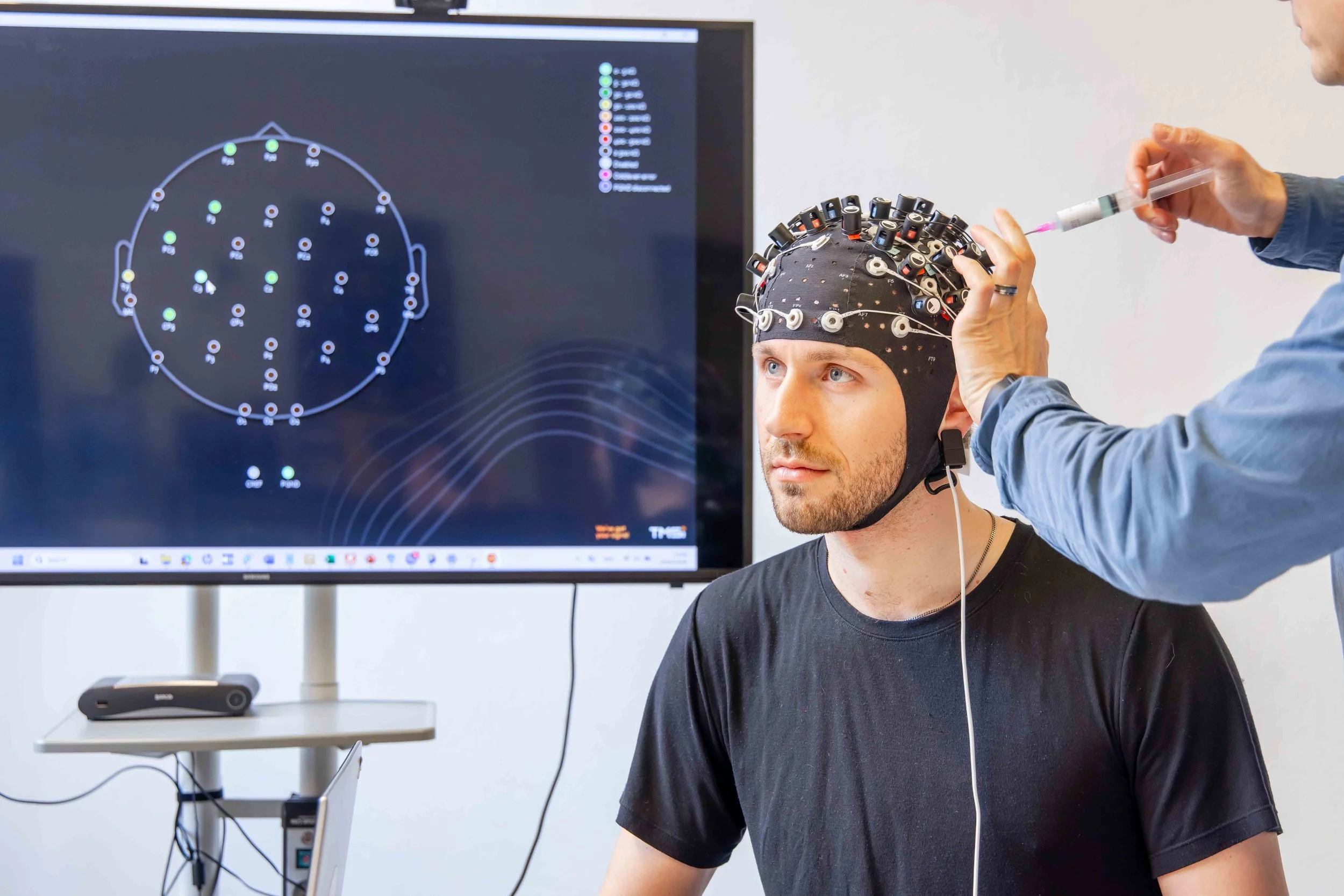
Contact us if you have questions about NIRScaps.
NIRS cap integration with other modalities
In addition to NIRS-EEG integration, NIRx offers cap integration solutions for other modalities that require access to a subject's head: NIRS-tDCS and NIRS-cochlear implants, for example. If you would like to integrate any other sensors with a NIRScap, please get in touch. Contact us if you have questions on NIRScaps.
NIRS Probes and Caps Comfort
fNIRS probes and caps must be fit properly and comfortably to ensure optimum signal quality. Caps must be snug but comfortable. An uncomfortable subject will not hold still or give good data. Many NIRS probes are incredibly uncomfortable and can only be worn for 30 minutes at the most before subjects must take them off. Not only are our standard probes comfortable, but we also offer specialized probes for long-term measurements and NIRS measurements on infants and children. Experimental time is precious. NIRx optodes are very easy to set up incredibly quickly, so that experimental time is spent on data collection.


Standard tip NIRS optode
For all-around use on adults, juveniles, and older children.

Blunt tip NIRS Optode
Ideal for use on neonatal infants to children.
Dual tip NIRS Optode (premium)
More comfortable than standard tips, more sensitivity in active detectors, faster setup.
Dual-tipped optodes as fiber optic laser sources, fiber optic LED sources, active LED sources, fiber optic detectors, and active detectors.
The spread of the force of impact to two points makes this style of probe excellent for sensitive subjects as well as adults.


Low-profile NIRS optode (premium)
Ideal for concurrent NIRS + TMS, NIRS + MRI, or NIRS + MEG.

NIRx low-profile probes lock in place, ensuring stable measurements.

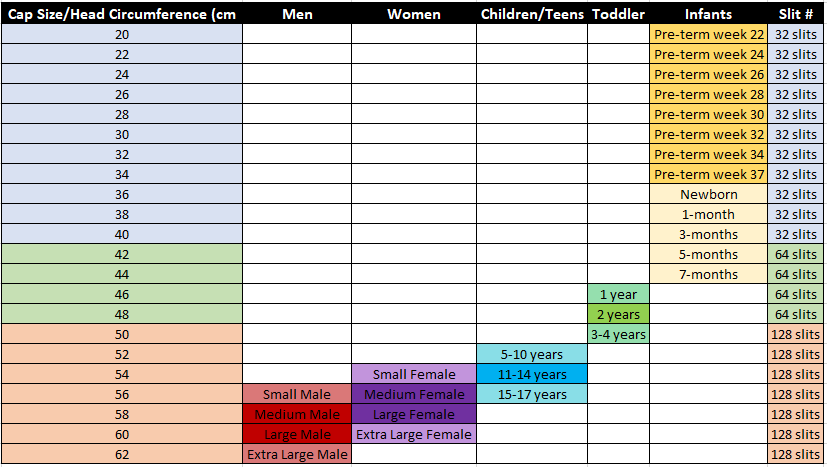
NIRx offers comfortable and properly-fitting caps for all subject ages.