
Concurrent fNIRS and Virtual Reality (VR)
Measure the brain in motion — inside any virtual world.
NIRx fNIRS systems record hemodynamic activity while participants move, explore, and interact in fully immersive VR. Because fNIRS tolerates motion and travels with the participant, it captures the brain at work inside virtual environments that other neuroimaging methods simply cannot reach.
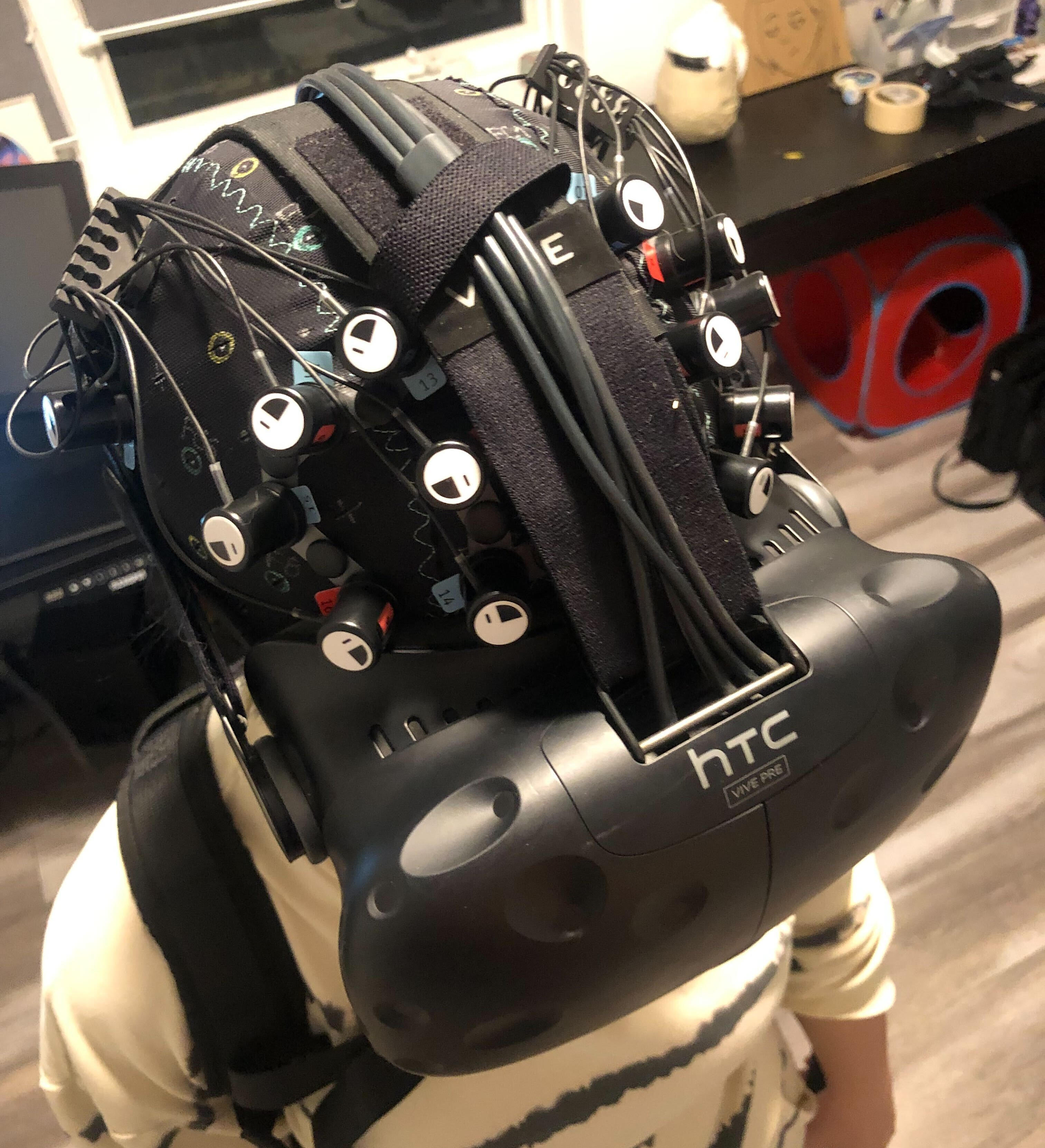
A NIRx fNIRS cap recorded concurrently with an HTC Vive headset: fNIRS and VR on one participant, at the same time.
Virtual Reality in Brain Research
Spatial cognition is an essential component of our daily lives, and Dr. da Silva's work delves into the connection between spatial abilities and performance in academic disciplines, particularly within the STEM fields. His research utilizes a cost-effective virtual reality (VR) headset combined with functional near-infrared spectroscopy (fNIRS) to objectively evaluate spatial cognition during mental rotation tasks (MRT) in both 3D and 2.5D conditions.
Virtual reality places participants inside realistic, fully controlled environments — a busy street to cross, a seminar room full of distractions, a rehabilitation exercise, a high-pressure emergency, a training or simulation scenario. Every element of the scene is repeatable and precisely timed, which gives researchers the experimental control of a lab study together with the ecological validity of a real-world experience. Pairing VR with functional near-infrared spectroscopy (fNIRS) adds the missing piece: a direct, continuous measure of what the brain is doing inside that environment.
Why Combine fNIRS and VR
fNIRS and VR are naturally complementary. VR defines and standardizes the experience; fNIRS measures the cortical response to it. Together, they let researchers study real-world cognition and behavior under conditions that would be impossible to recreate in a scanner.
fNIRS is uniquely suited to immersive VR:
• Motion tolerant: participants can turn their head, reach, gesture, stand, and walk while data keeps recording — the natural movements VR is built around.
• Wearable and wireless: a battery-operated NIRSport2 travels with the participant, with no scanner and no tether. The NIRSPort2 can be connected to the recording computer via wi-fi, making it fully wireless.
• Quiet and unobtrusive: fNIRS is silent and comfortable, so the immersive experience and spontaneous behavior are preserved.
• High temporal resolution: cortical responses can be aligned precisely to events in the virtual scene. The NIRSport2 recording software, Aurora, is LSL and TTL compatible: it can be linked to the most used VR software (e.g., Unity and Unreal Engine).
• Real-time capable: raw, unfiltered data can be streamed live for neurofeedback and closed-loop, neuroadaptive VR.
Unlike fMRI, fNIRS does not confine the participant or restrict movement, so the VR stays immersive, and the behavior stays natural.
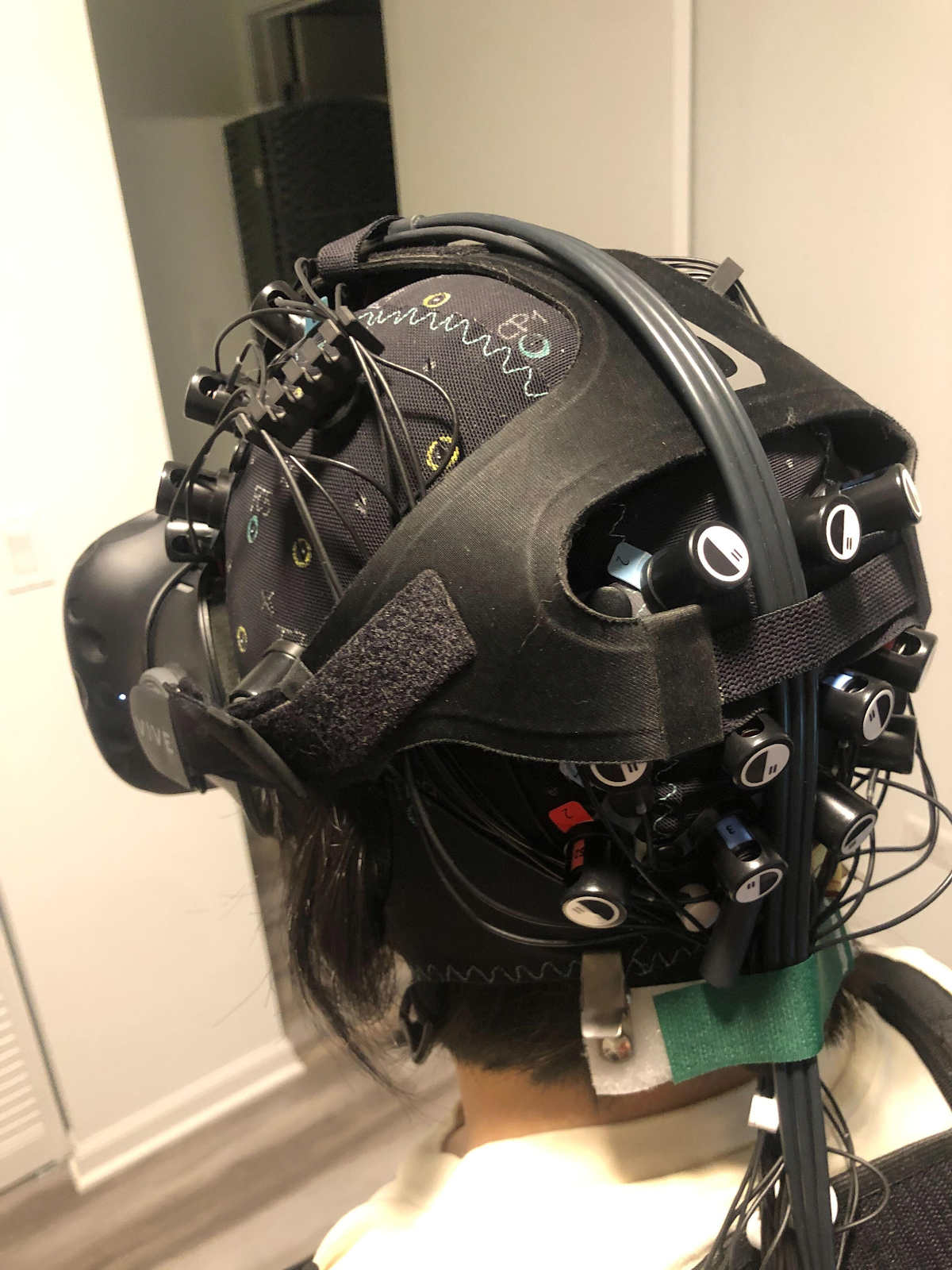
Optode cables are routed around the headset strap so the headset does not pull on the fNIRS probes, keeping signal quality stable as the participant moves.
How fNIRS and VR Work Together
NIRx systems are designed to record alongside the head-mounted displays researchers use most, including the HTC Vive, Meta Quest, Pico, and Valve Index families. The wearable NIRSport2 sits comfortably with the headset, and flexible caps and probe placement accommodate headset straps and back cushions.
Synchronization is straightforward. VR tasks are typically built in Unity or Unreal Engine — both free for academic use — and stream event markers to NIRx Aurora acquisition software over Lab Streaming Layer (LSL). Every stimulus, trial, and interaction in the virtual environment is time-stamped together with the fNIRS data, so brain activity and VR events are co-registered for analysis. Because Aurora exports raw, unfiltered data in real time, the same setup supports
neurofeedback and closed-loop designs in which the virtual environment responds to the participant’s brain state.
In short: if your VR task can send an LSL marker — and the major engines and headsets can — it can run concurrently with a NIRx system.
How NIRx fNIRS Synchronizes with VR
VR events stream to NIRx Aurora over Lab Streaming Layer (LSL)
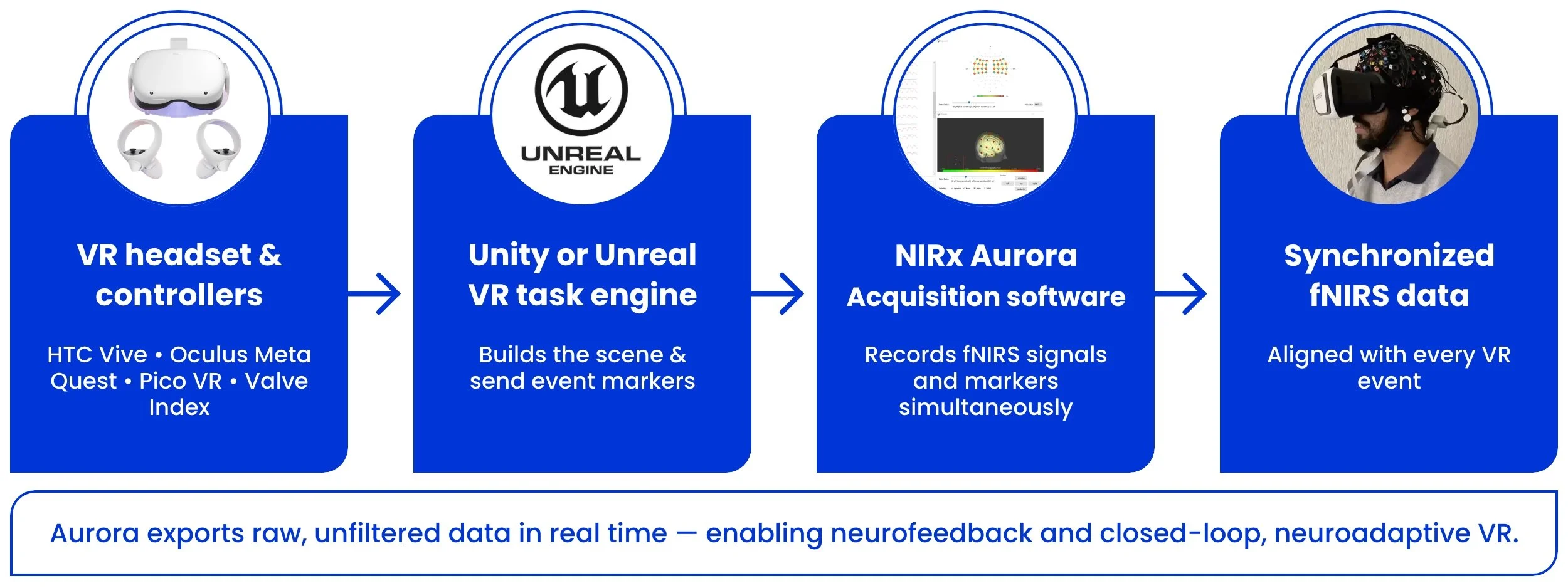
What you need to run fNIRS + VR
A NIRx fNIRS system — for example, the wearable, wireless NIRSport2
A VR headset — HTC Vive, Meta Quest, Pico, Valve Index, and other major models
A task built in Unity or Unreal Engine — both free for academic use
An LSL connection to NIRx Aurora — so VR events and brain data are recorded together
Featured Project: UFO — Neuroadaptive VR Training
The UFO project, built on NIRx GmbH fNIRS technology, shows what becomes possible when VR and fNIRS work as a closed loop. UFO is a virtual reality training application designed to strengthen cognitive skills — such as sustained attention and the ability to inhibit distractions — and to make mental workload tangible for autistic and other neurodivergent users.
While the participant plays, fNIRS measures the mental workload of working memory in real time. Algorithms classify the cognitive state on the fly, and the difficulty of the training adapts automatically to stay appropriately challenging. Feedback is delivered both visually and through tactile cues on the body, deepening immersion. UFO is a clear demonstration of neuroadaptive VR: an experience that reads the brain and responds to it, powered by NIRx fNIRS. Read the UFO project profile
Applications
Researchers around the world already pair fNIRS with VR across a wide range of fields:
• Neurorehabilitation and motor training. Immersive, gamified VR makes repetitive rehabilitation engaging, and fNIRS reveals the cortical activation that drives recovery. Examples include a gesture-controlled VR rhythm game with vibrotactile feedback for hand rehabilitation (Bae & Park, 2023) and a VR force-control training system studied across younger and older adults (Gan et al., 2025).
• Pain management. VR is increasingly used to modulate pain, and fNIRS helps explain how. One study examined the neural and behavioral correlates of VR-based pain modulation in subacute musculoskeletal injury (Mace et al., 2026).
• Neuroergonomics and cognitive workload. fNIRS in VR is used to study how people learn and perform under pressure — for example, assessing learning states in firefighters under stress (Abujelala et al., 2021) and comparing prefrontal activity as users evaluate physical, virtual, and mixed-reality product prototypes (Dybvik et al., 2025).
• Clinical and cognitive assessment. A controlled virtual seminar room combined fNIRS, EEG, and eye tracking to assess adult ADHD, showing how multimodal VR setups can characterize attention (Wiebe et al., 2023).
• Cognitive training and neurofeedback. As in the UFO project, fNIRS-driven neurofeedback turns VR into an adaptive training tool for attention and mental workload.
-
A curated selection of peer-reviewed fNIRS and VR research:
• Bae, S., & Park, H. S. (2023). Development of an immersive virtual reality-based hand rehabilitation system using a gesture-controlled rhythm game with vibrotactile feedback: an fNIRS pilot study. IEEE Transactions on Neural Systems and Rehabilitation Engineering, 31, 3732–3743.
• Gan, L., Lin, C. J., Chieh, H. F., An, K. N., & Su, F. C. (2025). A virtual reality force control training system on brain activation: functional near-infrared spectroscopy (fNIRS) study. JMIR Serious Games, 13, e63874.
• Mace, R. A., Wu, Z., Sieberg, C. B., Karunakaran, K. D., Peng, K., & Borsook, D. (2026). Virtual reality-based pain modulation in subacute musculoskeletal injury: functional near-infrared spectroscopy study of neural and behavioral correlates. JMIR Serious Games, 14, e77713.
• Abujelala, M., Karthikeyan, R., Tyagi, O., Du, J., & Mehta, R. K. (2021). Brain activity-based metrics for assessing learning states in VR under stress among firefighters: an explorative machine learning approach in neuroergonomics. Brain Sciences, 11(7), 885.
• Dybvik, H., Cox, C., Ormerod, I., et al. (2025). Users evaluating physical, virtual, and mixed reality prototypes exhibit differential DLPFC brain activity. Scientific Reports, 15, 39729.
• Wiebe, A., Aslan, B., Brockmann, C., et al. (2023). Multimodal assessment of adult attention-deficit hyperactivity disorder: a controlled virtual seminar room study. Clinical Psychology & Psychotherapy, 30(5), 1111–1129.
• Peng, K., Moussavi, Z., Karunakaran, K. D., Borsook, D., Lesage, F., & Nguyen, D. K. (2024). iVR-fNIRS: studying brain functions in a fully immersive virtual environment (review). Neurophotonics, 11(2), 020601.
Ready to Bring fNIRS into Your Virtual Environment?
NIRx systems are built for multimodal research & backed by lifetime technical support from a global team of fNIRS researchers and engineers. Tell us about your VR study, and we will help you design a setup that fits.
Click below to learn more about various applications with NIRS: