
How do I optimize my signal quality?
We are excited to share with you our latest video from our expert colleagues here at NIRx. In this latest release, Demetris take us step by step through the Signal Quality Guide. This guide provides you with the tips and tricks to make sure your signal quality is excellent before beginning your experiment.

This video goes through how to quantitatively and qualitatively assess signal quality.
In Part 1, Demetris takes us through how to assess signal quality. Part 2 shows how to troubleshoot the challenges when things are less than perfect. These two sections follow the Signal Quality Guidelines, available as a PDF on our Support Site. In Part 3, with the help of our colleagues, we show a real-time example of set up, checks, and troubleshooting.

NIRx Accessory Kits - Explainer Videos
What accessories can you expect with a fNIRS device from NIRx?
It’s arrived! What can you expect included in the delivery of your NIRx fNIRS system?
We have made some videos that give a walk-through of the items that will arrive in two of the three cases. These are the Starter Kit and Cap Kit. In these kits you will find everything that you need and more to prepare and run your fNIRS experiments with NIRx devices.
In the Starter Kit you'll find accessories to set up your experiment, these include a tape measure, links, headlamp and more.

In the Starter Kit Video, each item is described and it’s use explained. For example, Velcro straps are used for cable management.
The Cap Kit has all the items necessary for preparing your fNIRS cap. Here you’ll find your NIRScaps, optode holders and bases, short channels, phantom, and much more.

Cap Kit Video: a brief description of each item is given. In this screenshot we talk about the color-coded optode labels.
These clips are intended to get your experiments up and running in no time. We touch on each item in turn, and give a brief explanation of their uses.
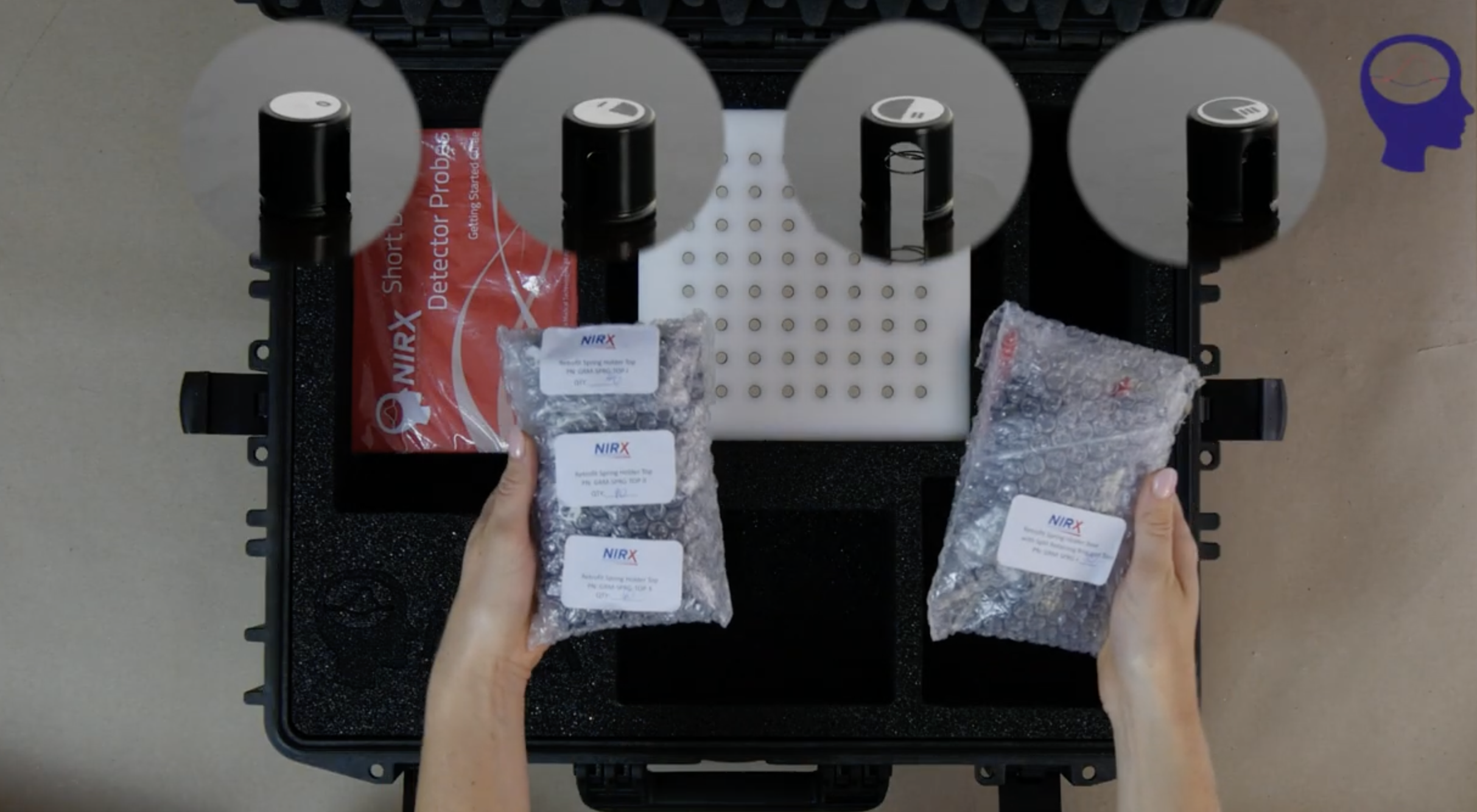
In the Cap Kit video we talk through the four different spring holder pressures.
Our extensive Support Site contains information on how to use our solutions . We have helped hundreds of scientists before. Please know that our support is free, and we are always happy to help.
You can reach us at support@nirx.net or talk to your consultant - they will put you in touch with the right expert.

Music, education and the brain
A report from UFABC, Brazil
Brains in Concert!
Below a small report from a unique event that took place earlier this year in São Paulo!
At the start of 2019, a very special event took place in the auditorium of the Hospital Israelita Albert Einstein, in São Paulo Brazil. The lucky 500 researchers and students that managed to secure a ticket, were able to experience a musical performance quite different from traditional concerts. While doctor Alicia Kowaltowski (Institute of Chemistry of the University of São Paulo (IQ-USP)) and neuroscientist Patrícia de Carvalho Aguiar (Einstein Brain Institute) played violin and cello, real-time oxygenation changes in their brain were projected above their heads!

This spectacular show was produced by Professor João Ricardo Sato, neuroscientist and statistician at the Center for Mathematics, Computing and Cognition at the Federal University of ABC (UFABC). Professor Sato is an expert fNIRS researcher, with a particular interest in applying hyper-scanning to study teaching and learning processes, as well as music cognition. During the event in January, the brain, music and education converged into a great spectacle. A full report of this event can be read in the online version of the Pesquisa FAPESP magazine (in Portuguese).
It’s not the first time this group is finding new and innovative ways to showcase fNIRS. Below is a video produced by the Neuroscience and Music group of UFABC during the presentation of the Orquestra Sinfônica de Santo André.
And, who has not seen the famous violin hyper-scanning video?
In February, Professor Sato and his colleagues published their work on studying brain activity in professional violinists in Frontiers in Psychology. Specifically, the group used fNIRS hyper-scanning to identify distinct patterns of brain activity for when the violinists were playing either as leader or as follower in musical duets. A great example of multi-subject studies in naturalistic environments!
Interested to read more about the work of Professor Sato? Below you will find A selection of recent publication:
VANZELLA, P. et al . fNIRS responses in professional violinists while playing duets: Evidence for distinct leader and follower roles at the brain level . Frontiers in Psychology . Feb. 2019.
BROCKINGTON, G. et al . From the laboratory to the classroom: The potential of functional near-infrared spectroscopy in educational neuroscience . Frontiers in Psychology . Oct. 2018 .
BALARDIN, Joana B. et al . Imaging brain function with functional near-infrared spectroscopy in unconstrained environments . Frontiers in Human Neuroscience . May. 2017.
New to fNIRS and interested to see if our hyper-scanning solutions can enhance your research? Or looking to advance your ongoing fNIRS work and take it to natural environments? Please do not hesitate to Contact us!

NIRSport seen on television
Dr. Daniel Carius measures brain activity during Basketball
Our hands are versatile and we depend on them every day. But how do they work exactly and why is it easier to do some things with one hand than with the other?
A recent episode of the German/French tv-show Xenius dived into the interesting world of hands. In the excerpt below, sports scientist Dr. Daniel Carius of Leipzig University shows and explains which brain regions are activated during basketball when playing with the right hand (dominant), and left hand (non-dominant).
Interested to watch the full episode of Xenius? Until May 8, the full episode of Xenius is available on the Arte website: https://www.arte.tv/de/videos/069854-012-A/xenius-haende/.
Note: Unfortunately, the show is available in German and French language only!