
Tutorial Video Series: Take your Research to the Next Level with Satori!
As an fNIRS researcher, you understand the importance of staying at the forefront of knowledge and technology. To this end, NIRx Medical Technologies and Brain Innovation launched in 2022 an innovative software product called Satori. Satori is an easy-to-use and powerful fNIRS analysis software. It includes the current standard fNIRS processing methods and statistical tools. Check out a recent overview video here.
As part of a commitment to support our customers, we have created a comprehensive playlist of training videos for researchers starting out with this state-of-the-art software. From setting up preprocessing pipelines to accessing data analysis tools, this Tutorial Series provides a clear overview of the Satori interface, enabling researchers to maximize their efficiency. In this blog post, we will take a look at what you can expect from these videos. We hope they can help you get started with Satori and bring you closer to your next publication.
Mastering the Satori Interface
The Satori software tutorial series begins with an introduction to the user interface, ensuring that researchers become familiar with its features and functionalities. This helps users navigate through the software with ease, saving valuable time and streamlining their workflow. There is a clip describing the event manager where users can easily edit their experimental paradigm ready for preprocessing and analysis.
The videos also guide users through the workflow manager in which all Satori’s features such as transformations, preprocessing, post-processing, and analysis steps, can be dragged into a clear visualisation tool. This can be easily shared with your collaborators.

Data preprocessing and analysis
One of the most valuable aspects of Satori's software tutorial series is the focus on data preprocessing and analysis methods readily available within the software. These techniques are based on the most common and robust methods in the literature. The videos offer guidance on preprocessing options specific to your data. Researchers are shown the built-in methods like temporal filtering, short channel regression (in both preprocessing and analysis), normalization, channel rejection, and motion correction parameters such as TDDR (temporal derivative distribution repair), CBSI (correlation-based signal improvement), and spike correction. You can also learn how to configure each option in advanced settings.

These videos also provide information on how to analyse experiments within Satori. With the tutorial on running a single study GLM, users are shown how to set up the analysis, manage statistical parameters and thresholds, setting contrasts and including confound regressors. Satori is also able to run multi-study GLM analysis, SVM training, cross- and anti- correlation.
Advanced Data Visualization and Interpretation
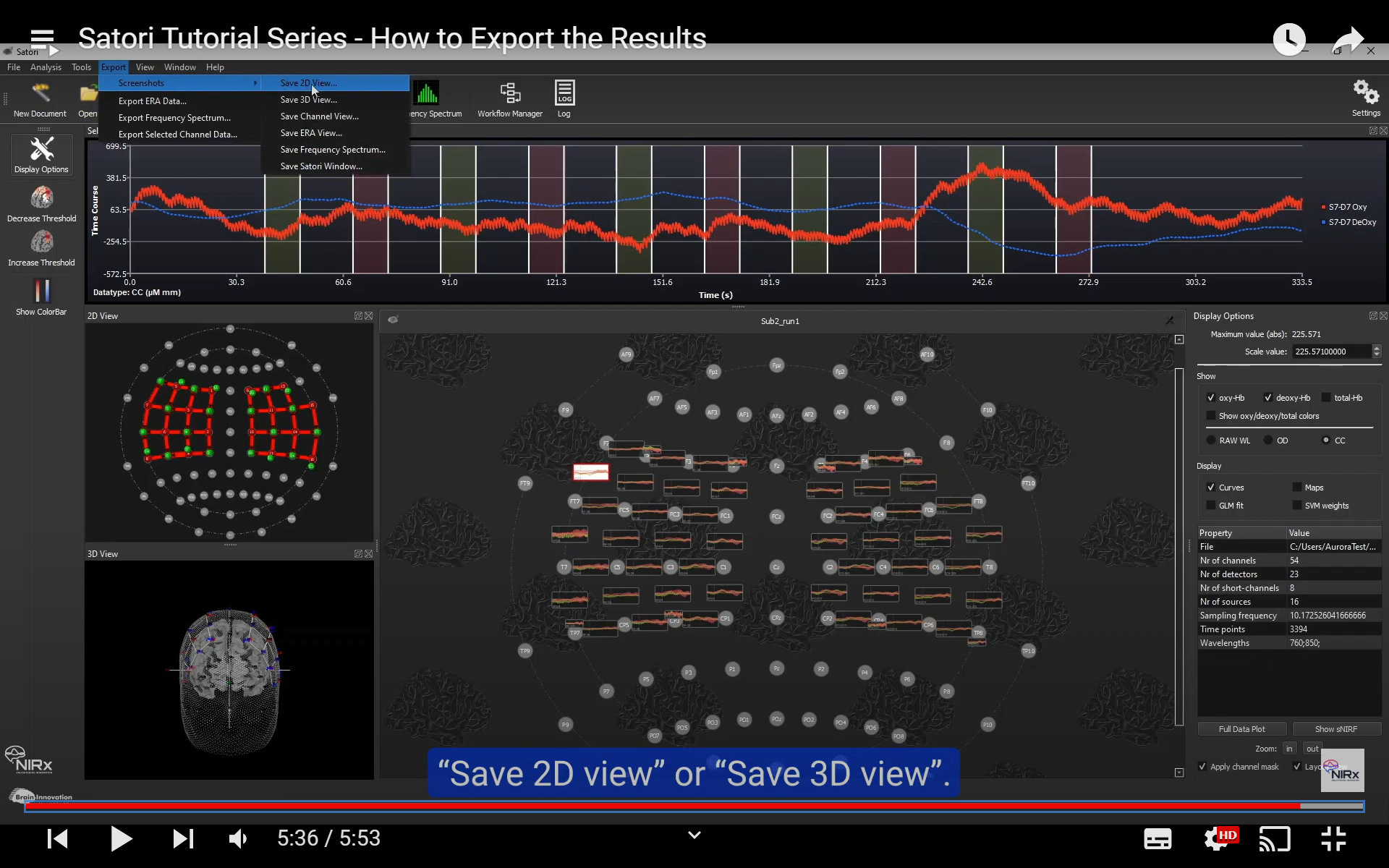
Data visualization is key to effectively communicating research findings. With Satori, this is accessible in just a few clicks. Satori's software training videos provide researchers with a quick overview of the data visualization techniques included. Part 2 of the single study GLM tutorial gives an example of how these visualization tools can be leveraged to transform complex data sets into clear, insightful visual representations with simple customization options for thresholds. These channel maps, graphs, and images can then be easily exported. These videos teach scientists how to display their data in a visually appealing manner within Satori, enhancing the dissemination and understanding of their research.
Extend Satori 2.0 with Python
We are excited to announce that the latest release, Satori 2.0 has inbuilt integration with Python. You can expand the capabilities of the software with your own scripts! We hope this interoperability empowers researchers to combine the strengths of Satori with other tools you may already be using, fostering a flexible and tailored approach to your research projects. Check out our recent webinar on these new features of Satori.
Conclusion
Scientific research is a dynamic and ever-evolving field, and staying ahead requires continuous learning and the adoption of cutting-edge technologies. Satori empowers researchers to get to the heart of their data with ease, without having to code a single line.
From mastering the software interface to preprocessing, analysis, advanced visualization, and integration with third-party tools, Satori's tutorial videos offer a helpful resource for researchers, equipping them with the skills and knowledge necessary to unlock their full potential with this fNIRS software.
Take your research to the next level with Satori! Subscribe to our Youtube Channel for more videos to come as features are added to Satori or contact us at consulting@nirx.net to find out more.

How do I optimize my signal quality?
We are excited to share with you our latest video from our expert colleagues here at NIRx. In this latest release, Demetris take us step by step through the Signal Quality Guide. This guide provides you with the tips and tricks to make sure your signal quality is excellent before beginning your experiment.

This video goes through how to quantitatively and qualitatively assess signal quality.
In Part 1, Demetris takes us through how to assess signal quality. Part 2 shows how to troubleshoot the challenges when things are less than perfect. These two sections follow the Signal Quality Guidelines, available as a PDF on our Support Site. In Part 3, with the help of our colleagues, we show a real-time example of set up, checks, and troubleshooting.

Um Workshop de fNIRS na America latina / fNIRS Workshop in Latin America!
Written by: Cesar Noronha, M
Pictures: Mariana Ceci/Ascom ISD
(Português abaixo)
fNIRS Workshop in Latin America!
2022 started off on the right foot in Latin America with workshops for participants from all regions of Brazil!
In February, NIRx, together with Brain Support, and Instituto Santos Dumont, hosted a two-day workshop with presentations and hands-on sessions. This event featured morning lectures and practical sessions in the afternoons.
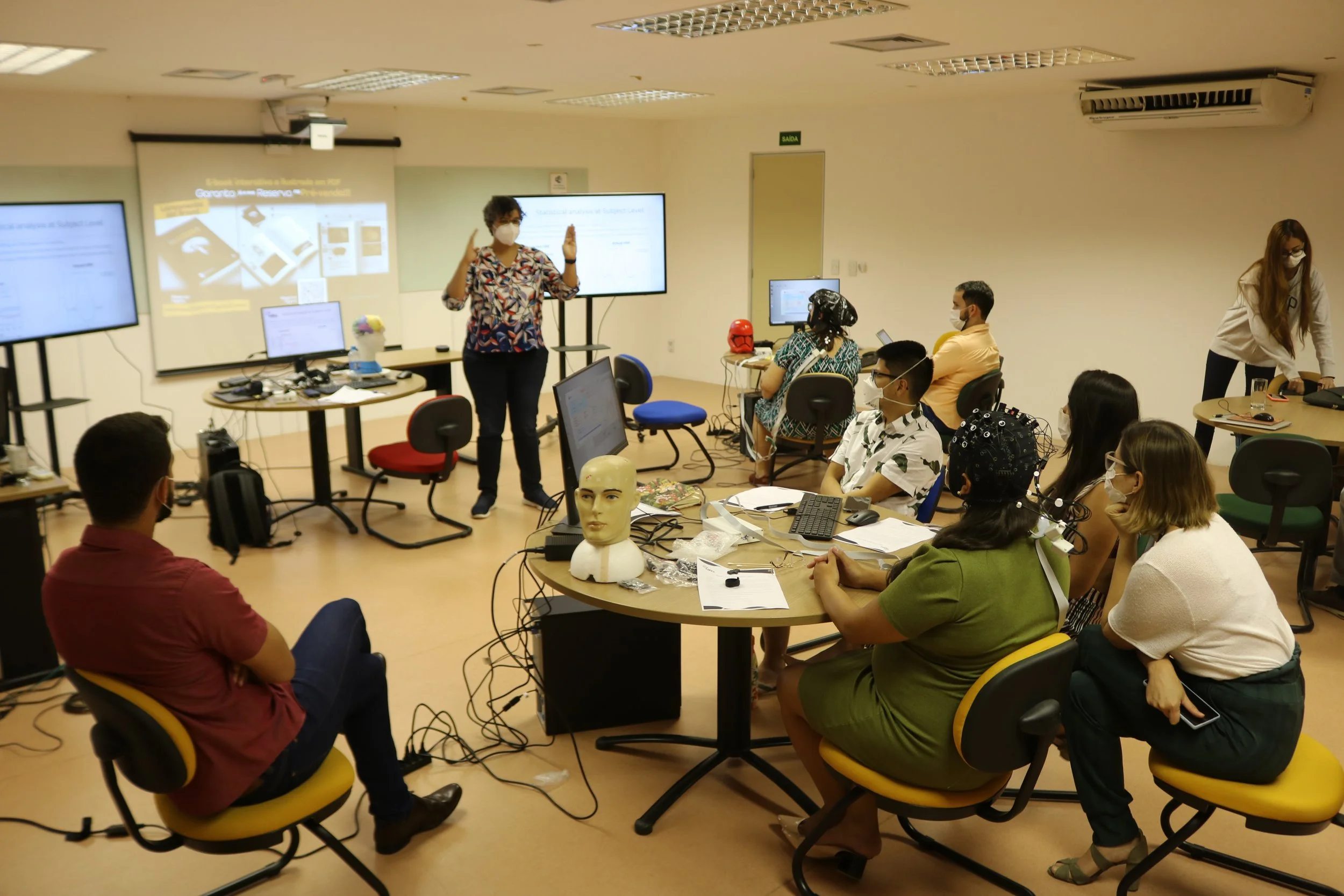
Maria Adelia presenting the hands-on session.
In the mornings, international speakers were invited to talk about their fNIRS research. They introduced advantages of fNIRS, challenges, experimental design, special considerations and analyses. On the last day, NIRx held a closing talk discussing the fundamentals of fNIRS.

Cesar Noronha setting up the NIRS cap.
In the afternoons, there were practical sessions demonstrating NIRSport2 data acquisition on the first day, and NIRSport1 on the second day. This was all streamed online.
After the sessions, we worked with each research group on their specific questions and challenges. The focus of the first day was the assembly design and data acquisition and the second day was the analysis and interpretation.
Representatives of at least 4 different research groups that use or want to use fNIRS in their research were present. We love to share fNIRS technology. Check out our webinars or events pages for more upcoming workshops.
The lectures are in Instituto Santos Dumont open YouTube channel for sharing:
NIRx Staff - Maria Adelia de Aratanha, Cesar Noronha
Brain Support Staff - Daniel Machado
Um Webinar de fNIRS na America latina!
Iniciamos 2022 com o pé direito na américa latina! Realizamos seminários com convidados de varias regiões do Brasil!
Em Fevereiro os pesquisadores e entusiastas de fNIRS da America Latina tiveram um evento para chamar de seu. A NIRx junto da Brain Suport e o Instuto Santos Dumont realizaram um webinar de dois dias com apresentações e sessões de hands-on!

Maria Adelia explains the multiplicity of fNIRS systems
Este foi um workshop de dois dias muito interessante. Tivemos palestras inteiras de manhã e NIRx e sessões práticas durante as tardes. Pela manhã tivemos palestrantes internacionais falando sobre suas pesquisas com fNIRS, desafios, vantagens, desenho experimental, considerações especiais e análises. No último dia, o NIRx realizou uma palestra de encerramento falando sobre os fundamentos do fNIRS.
Na parte da tarde, tivemos uma sessão prática gravada onde mostramos a aquisição de dados NIRSport2 no primeiro dia e NIRSport1 no segundo dia. Após a sessão gravada, trabalhávamos com cada grupo de pesquisa em suas questões e desafios específicos. O foco do primeiro dia foi o desenho da montagem e aquisição de dados e no segundo dia foi a análise e interpretação.

Researchers from different laboratories discuss an experimental design proposed during the seminar
Tivemos a presença de representantes de pelo menos 4 diferentes grupos de pesquisa que utilizam ou utilização fNIRS em suas pesquisas. Os pesquisadores presentes além de elogiarem bastante o webinar já perguntaram quando será o próximo!
As palestras estão no canal do YouTube do Instituto Santos Dumont aberto para compartilhamento:

The Latin America fNIRS community in attendance
Thank you to all who attended! See you next time!

NIRx Accessory Kits - Explainer Videos
What accessories can you expect with a fNIRS device from NIRx?
It’s arrived! What can you expect included in the delivery of your NIRx fNIRS system?
We have made some videos that give a walk-through of the items that will arrive in two of the three cases. These are the Starter Kit and Cap Kit. In these kits you will find everything that you need and more to prepare and run your fNIRS experiments with NIRx devices.
In the Starter Kit you'll find accessories to set up your experiment, these include a tape measure, links, headlamp and more.

In the Starter Kit Video, each item is described and it’s use explained. For example, Velcro straps are used for cable management.
The Cap Kit has all the items necessary for preparing your fNIRS cap. Here you’ll find your NIRScaps, optode holders and bases, short channels, phantom, and much more.

Cap Kit Video: a brief description of each item is given. In this screenshot we talk about the color-coded optode labels.
These clips are intended to get your experiments up and running in no time. We touch on each item in turn, and give a brief explanation of their uses.
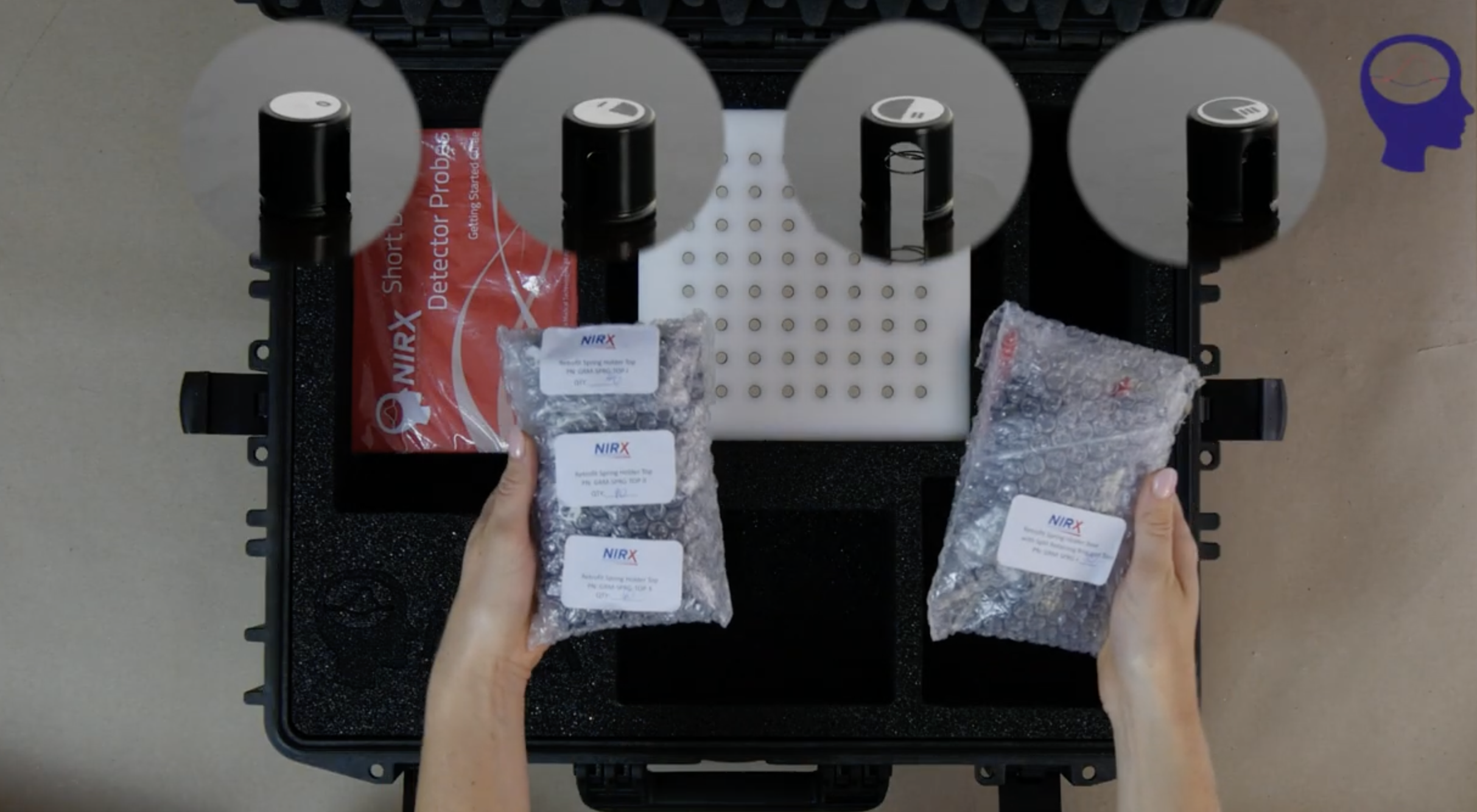
In the Cap Kit video we talk through the four different spring holder pressures.
Our extensive Support Site contains information on how to use our solutions . We have helped hundreds of scientists before. Please know that our support is free, and we are always happy to help.
You can reach us at support@nirx.net or talk to your consultant - they will put you in touch with the right expert.

Music, education and the brain
A report from UFABC, Brazil
Brains in Concert!
Below a small report from a unique event that took place earlier this year in São Paulo!
At the start of 2019, a very special event took place in the auditorium of the Hospital Israelita Albert Einstein, in São Paulo Brazil. The lucky 500 researchers and students that managed to secure a ticket, were able to experience a musical performance quite different from traditional concerts. While doctor Alicia Kowaltowski (Institute of Chemistry of the University of São Paulo (IQ-USP)) and neuroscientist Patrícia de Carvalho Aguiar (Einstein Brain Institute) played violin and cello, real-time oxygenation changes in their brain were projected above their heads!

This spectacular show was produced by Professor João Ricardo Sato, neuroscientist and statistician at the Center for Mathematics, Computing and Cognition at the Federal University of ABC (UFABC). Professor Sato is an expert fNIRS researcher, with a particular interest in applying hyper-scanning to study teaching and learning processes, as well as music cognition. During the event in January, the brain, music and education converged into a great spectacle. A full report of this event can be read in the online version of the Pesquisa FAPESP magazine (in Portuguese).
It’s not the first time this group is finding new and innovative ways to showcase fNIRS. Below is a video produced by the Neuroscience and Music group of UFABC during the presentation of the Orquestra Sinfônica de Santo André.
And, who has not seen the famous violin hyper-scanning video?
In February, Professor Sato and his colleagues published their work on studying brain activity in professional violinists in Frontiers in Psychology. Specifically, the group used fNIRS hyper-scanning to identify distinct patterns of brain activity for when the violinists were playing either as leader or as follower in musical duets. A great example of multi-subject studies in naturalistic environments!
Interested to read more about the work of Professor Sato? Below you will find A selection of recent publication:
VANZELLA, P. et al . fNIRS responses in professional violinists while playing duets: Evidence for distinct leader and follower roles at the brain level . Frontiers in Psychology . Feb. 2019.
BROCKINGTON, G. et al . From the laboratory to the classroom: The potential of functional near-infrared spectroscopy in educational neuroscience . Frontiers in Psychology . Oct. 2018 .
BALARDIN, Joana B. et al . Imaging brain function with functional near-infrared spectroscopy in unconstrained environments . Frontiers in Human Neuroscience . May. 2017.
New to fNIRS and interested to see if our hyper-scanning solutions can enhance your research? Or looking to advance your ongoing fNIRS work and take it to natural environments? Please do not hesitate to Contact us!

NIRSport seen on television
Dr. Daniel Carius measures brain activity during Basketball
Our hands are versatile and we depend on them every day. But how do they work exactly and why is it easier to do some things with one hand than with the other?
A recent episode of the German/French tv-show Xenius dived into the interesting world of hands. In the excerpt below, sports scientist Dr. Daniel Carius of Leipzig University shows and explains which brain regions are activated during basketball when playing with the right hand (dominant), and left hand (non-dominant).
Interested to watch the full episode of Xenius? Until May 8, the full episode of Xenius is available on the Arte website: https://www.arte.tv/de/videos/069854-012-A/xenius-haende/.
Note: Unfortunately, the show is available in German and French language only!

Can Cycling Boost Mental Health?
Watch the video report!
The NIHR Oxford Health Biomedical Research Centre recently had their spectacular research featured in a 20-minute GCN Does Science Video!
With mental health becoming an increasingly discussed topic, scientists are seeking to evaluate strategies to maintain or even promote mental health. Ground-breaking new research done by the NIHR Oxford Health Biomedical Research Centre is now using fNIRS to show that cycling can be hugely beneficial for improving mental health. Interested to learn how? Find out by watching their amazing video report!
NIRx functional near-infrared spectroscopy instruments allow for world-class scientific research in almost any environment imaginable. For an impression of other successful projects, have a look at a sample of peer-reviewed publications.
Interested to start a (new) fNIRS project with your lab? Please do not hesitate to contact us as we are looking forward to talk to you!