
Um Workshop de fNIRS na America latina / fNIRS Workshop in Latin America!
Written by: Cesar Noronha, M
Pictures: Mariana Ceci/Ascom ISD
(Português abaixo)
fNIRS Workshop in Latin America!
2022 started off on the right foot in Latin America with workshops for participants from all regions of Brazil!
In February, NIRx, together with Brain Support, and Instituto Santos Dumont, hosted a two-day workshop with presentations and hands-on sessions. This event featured morning lectures and practical sessions in the afternoons.
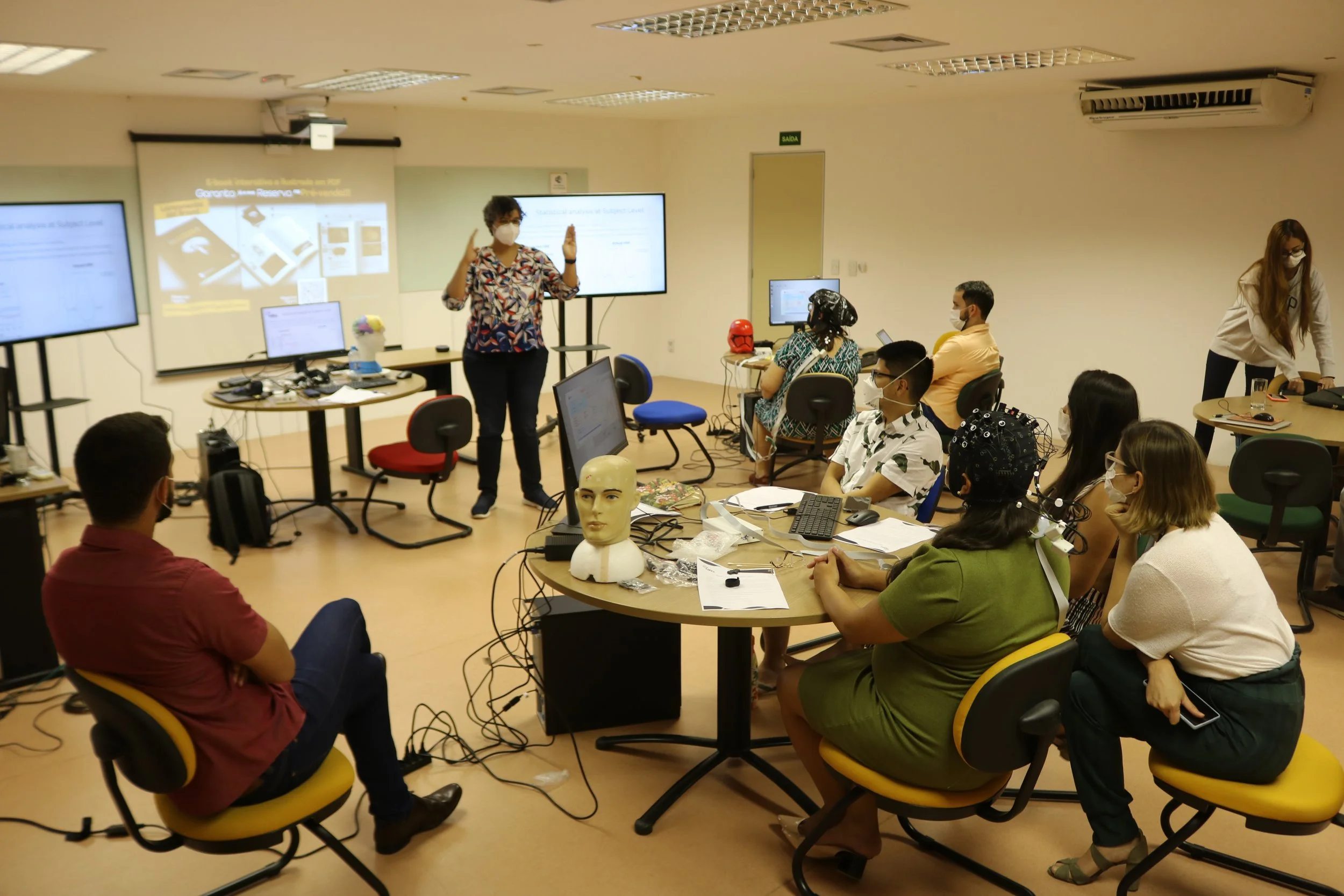
Maria Adelia presenting the hands-on session.
In the mornings, international speakers were invited to talk about their fNIRS research. They introduced advantages of fNIRS, challenges, experimental design, special considerations and analyses. On the last day, NIRx held a closing talk discussing the fundamentals of fNIRS.

Cesar Noronha setting up the NIRS cap.
In the afternoons, there were practical sessions demonstrating NIRSport2 data acquisition on the first day, and NIRSport1 on the second day. This was all streamed online.
After the sessions, we worked with each research group on their specific questions and challenges. The focus of the first day was the assembly design and data acquisition and the second day was the analysis and interpretation.
Representatives of at least 4 different research groups that use or want to use fNIRS in their research were present. We love to share fNIRS technology. Check out our webinars or events pages for more upcoming workshops.
The lectures are in Instituto Santos Dumont open YouTube channel for sharing:
NIRx Staff - Maria Adelia de Aratanha, Cesar Noronha
Brain Support Staff - Daniel Machado
Um Webinar de fNIRS na America latina!
Iniciamos 2022 com o pé direito na américa latina! Realizamos seminários com convidados de varias regiões do Brasil!
Em Fevereiro os pesquisadores e entusiastas de fNIRS da America Latina tiveram um evento para chamar de seu. A NIRx junto da Brain Suport e o Instuto Santos Dumont realizaram um webinar de dois dias com apresentações e sessões de hands-on!

Maria Adelia explains the multiplicity of fNIRS systems
Este foi um workshop de dois dias muito interessante. Tivemos palestras inteiras de manhã e NIRx e sessões práticas durante as tardes. Pela manhã tivemos palestrantes internacionais falando sobre suas pesquisas com fNIRS, desafios, vantagens, desenho experimental, considerações especiais e análises. No último dia, o NIRx realizou uma palestra de encerramento falando sobre os fundamentos do fNIRS.
Na parte da tarde, tivemos uma sessão prática gravada onde mostramos a aquisição de dados NIRSport2 no primeiro dia e NIRSport1 no segundo dia. Após a sessão gravada, trabalhávamos com cada grupo de pesquisa em suas questões e desafios específicos. O foco do primeiro dia foi o desenho da montagem e aquisição de dados e no segundo dia foi a análise e interpretação.

Researchers from different laboratories discuss an experimental design proposed during the seminar
Tivemos a presença de representantes de pelo menos 4 diferentes grupos de pesquisa que utilizam ou utilização fNIRS em suas pesquisas. Os pesquisadores presentes além de elogiarem bastante o webinar já perguntaram quando será o próximo!
As palestras estão no canal do YouTube do Instituto Santos Dumont aberto para compartilhamento:

The Latin America fNIRS community in attendance
Thank you to all who attended! See you next time!

fMRI and fNIRS: Comparative Paradigms
Summary of the Houston Workshop: fMRI and fNIRS: Comparative Paradigms, with Dr. Tom Zeffiro of the Baltimore VA
General Summary

Recently, NIRx Medical Technologies hosted a workshop at The University of Houston with guest speaker and fMRI expert, Dr. Tom Zeffiro.
Dr. Zeffiro has now worked in fMRI for several decades and has now worked in the field of fNIRS for sometime as well. Due to the increased popularity of the modality, Dr. Zeffiro has decided to transition his passion and related knowledge of fMRI into the field of fNIRS. This combination of modalities is near perfect as the BOLD signal of fMRI is so highly related with the hemodynamic response of fNIRS.
The purpose of this workshop was to build on and apply the current knowledge of fMRI into the field of fNIRS to create a useable and understandable methodology for any fNIRS user. There are several reasons why this purpose would useful for fNIRS users.
The first reason is simply due to the larger number of publications in fMRI that are completely (or at least near-completely) translatable into the realm of fNIRS. This allows fNIRS users a wider range of documentation and resources when conducting their experiments, and creates a valuable repository to help answer questions that arise when current fNIRS repositories fall short.
Additionally, this purpose also aimed to build on the often more established topics in fMRI and translate the information to the fresher realm of fNIRS. This would enable researchers who might be currently familiar to fMRI but perhaps new to fNIRS to gain a more stable first footing into the field.
The workshop was split into a 2-day program covering the basics of fMRI experimentation, signal processing, and analysis through to the translation of these topics into fNIRS. The talk focused on similarities, incongruencies, and applications in both technologies.
Day 1

Dr. Zeffiro began the workshop spanning the breadth of fMRI. This included a broad overview of the technology, sparing the crowd from many of the intrinsically deep details.
During the day, the conversation never touched heavily on any specific application, nor did it demonstrate any real analysis, but during the conversation, Dr. Zeffiro did share anecdotes about popular studies in the field. The day focused on introducing the attendees to the fabric of fMRI, ensuring an all-encompassing overview of the field. While initially a bit overwhelming in information, Dr. Zeffiro proved his experience in delivering these workshops on day 2, when the course came full circle tying in each concept introduced during day 1 to its application and reason.
Day 2
Entering day 2, Dr. Zeffiro clearly had a method to his madness as he calmly and astutely began to connect each of the dots presented in the previous day’s talk. There was clear relief and several “a-ha’s’ being exuded from the crowd as each audience member found moments of genius in the unsuspecting plan.
fNIRS came to the forefront of day 2 with fMRI simply adding the support beams to the explanations of the technology. Applications and technical acuity began to seep more and more into the conversations. Lending a more hands-on feel, without Dr. Zeffiro having to provide individual guidance.

Dr. Zeffiro’s opening topic, “what should you first do when you get a device?” started the day with curiousity and led the path of discussion all the way through analysis. The conversation led to the first experiment one should do with their system, enabling users to fully understand the technology, the device, the data, and the analysis.
Fingertapping enables the learning curve because it is such a simple task to understand, simple in its physicality, and simple in its cognitive load. The response to tapping fingers is large, and the response is quite intuitive to most brain scientists. The outcome should be a large response in the motor region. There may or may not find contra-laterality, but if all things are working properly, you absolutely will find a motor response, and therefore nearly guaranteed usable data to work with.
The day continued from this simple paradigm adding levels of complexity to the task. Showing the audience how one may alter the experimental question using simple steps, correcting the experimental paradigm, and eventually what accompanying analytical changes would be made to appropriately measure these more complex levels.
Each step was described in great and understandable detail. Many common processing and analysis steps were explained with the questions, “what”, “why”, and “how”.
In Closing
The workshop encompassed an enormous amount information during a two-day period, but brought a range of researchers into an environment focused on complicated topics in neuro-imaging while maintaining a focus on simplifying each topic to its bones.
The workshop enabled an open atmosphere for questions and discussion, and often detoured down the appropriate paths to ensure the audience was able to have all needed questions answered. Dr. Zeffiro was able to maintain this environment during both days while keeping his focus on the intended program.
We hope all attendees found use in their attendance, and we hope this summary does the workshop justice. If we happened to miss you for this first course, we look forward to seeing you in future courses!

Upcoming event – Hands on next generation fNIRS. 8th of June, Rome
Reserve your spot now - limited availability
We would hereby like to warmly invite you to the Rethink Functional Imaging – Hands on next generation fNIRS event, organized by NIRx Medical Technologies and Brain Innovation. This one-day workshop introduces a new platform for wearable, whole-head functional near-infrared spectroscopy, from signal acquisition to data analysis. The event takes place on June 8; just before the official OHBM annual meeting starts. Claim your spot for this event on http://rethinkfnirs.eventbrite.com, or read more information below!
A little over 30 years ago, NIRx introduced the concept of multi-distance spectroscopy measurements – tomographic brain imaging using near-infrared light. Together with Brain Innovation, pioneer of advanced analysis and mapping of structural and functional brain data. Now, we are presenting an all-new way of studying brain activity, integrating the entire research workflow.
Join us for an interactive demonstration of the NIRSport 2, the wearable whole-head imaging platform. Try its powerful multi-device mode, and run whole-head measurements in almost any environment imaginable. Visualize hemodynamic changes with Aurora, the latest fNIRS acquisition software, and experience its potential for multi-modal research.
This event marks the premiere of our latest collaborative effort: an all-new analysis software. Get inspired, and be part of the newest developments in mobile neuroimaging. Meet the community and learn about ongoing efforts. Rethink your study, and rethink fNIRS.
The event is scheduled from 10am to 3pm, June 8, with admission free of charge. Final schedule, program and venue to be announced. Places are limited, so register now!
We very much look forward to welcoming you in Rome.