

Discover the Power of Satori 2.0: New Features Unveiled!
We are excited to announce the upcoming release of Satori 2.0 in mid-August!
Since the first launch of Satori in 2022, Brain Innovation and NIRx have been collecting feedback from fNIRS scientists about the most important features to include in the next version of the software. With Satori 2.0, we are thrilled to introduce these new and updated features that will enhance your data preprocessing and analysis capabilities. For summaries of the features already available in Satori, check out our tutorial series on YouTube.
In this blog post, we will delve into three key additions:
Python Based Solutions,
The data plotter,
Integrated user guides.
So let's dive in and explore the possibilities of Satori 2.0!
1. Python Integration
One of the most prominent additions are the Python functions executable within the Satori User Interface. Not only can you harness the power of existing Python algorithms and features, but you can also develop and include custom functionalities. This extensibility allows for the rapid expansion of fNIRS algorithms and the incorporation of novel features developed by the scientific community.
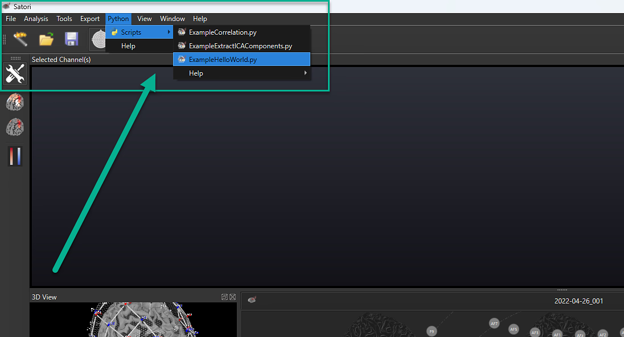
There are two ways Python is integrated into Satori. With the Python Scripts directly executable from the Satori header menu, you can take full control of your data processing pipelines.
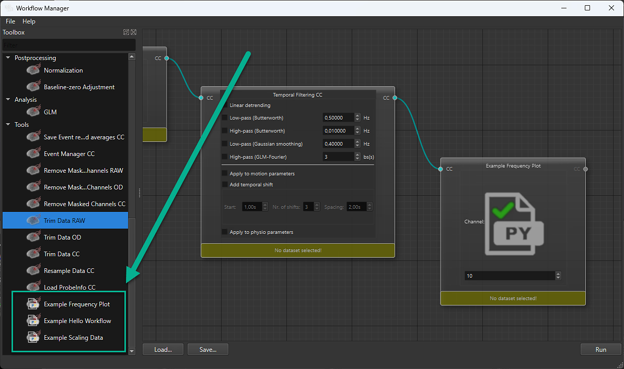
In the Workflow Manager, you can load data and seamlessly incorporate Python Based Workflow Modules which are pre-processing or post-processing the data. We have already included some example scripts which are supported by NIRx and Brain Innovation and documented in the integrated user guide.
2. Data Plotter
Satori 2.0 introduces an exciting new feature, the data plotter. In the data plotter, you can load datasets and view multiple channels simultaneously. While the Selected Channels view allowed for the viewing of multiple channels within a dataset, Satori 2.0 takes it a step further by enabling the visualization of channels from different datasets and the ability to include or exclude specific processing steps. By comparing different pre-processing steps, zooming in on time series data, and toggling the visibility of channels, you gain deeper insights into your data, quickly and easily. The data plotter also allows you to add peripheral physiology, such as data from NIRxWINGS, for a comprehensive analysis.
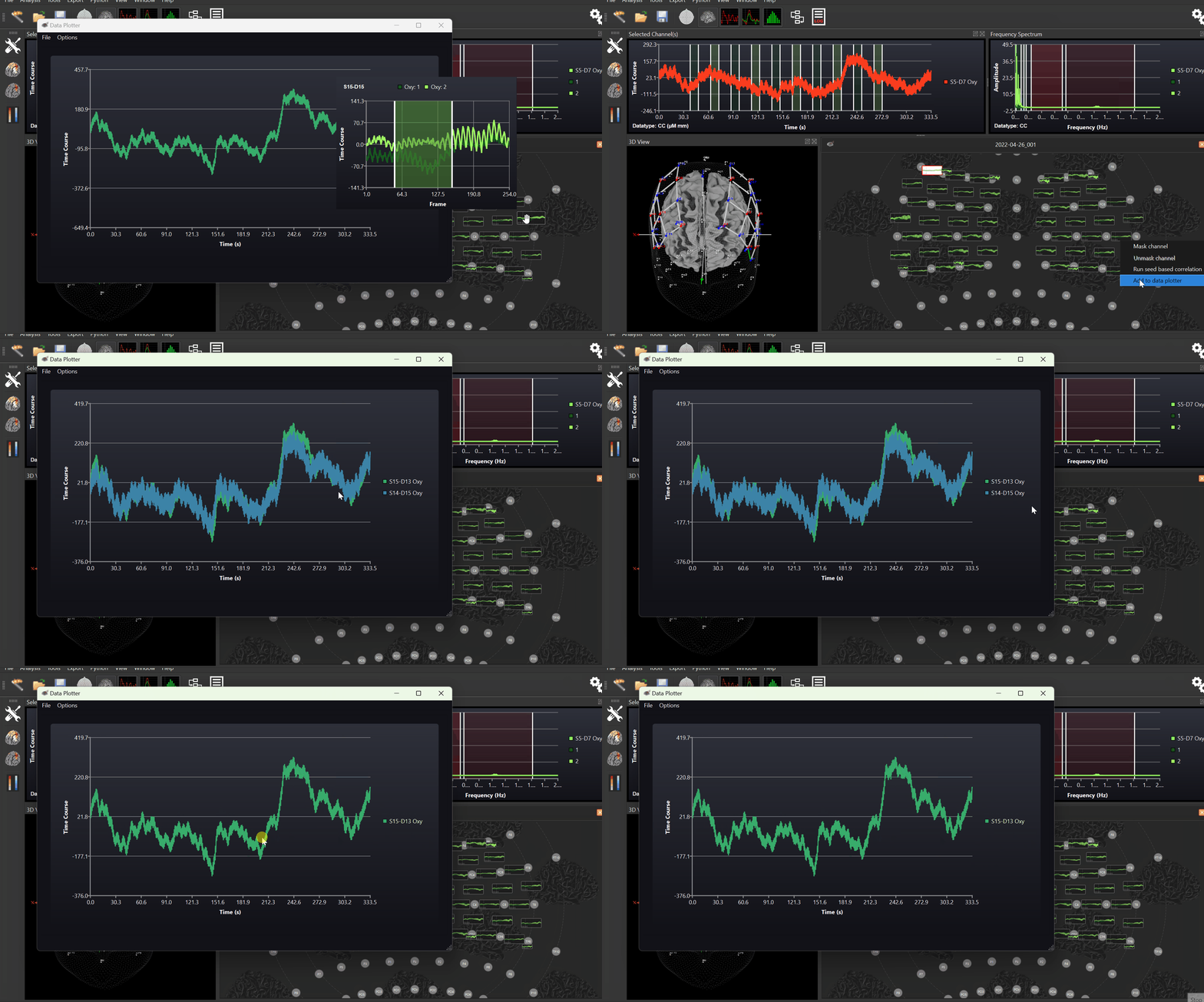
Of course, Satori 2.0 also brings enhancements to the user interface GUI, making your data analysis experience even more seamless. With improved window scaling, navigating through your data becomes more intuitive and efficient. Beyond the data plotter, additional data and analysis results viewing options are now available.
3. Integrated User Guide
We are excited to announce that improved documentation features accompany each processing step in the modules in the workflow manager and certified Python scripts. This is part of our commitment to equip users with the knowledge, instructions, and resources they need to effectively navigate the software and processing steps. To this end, we also have released a series of training videos available on our YouTube channel. With this comprehensive documentation, we hope users can quickly understand the functionalities of, and concepts behind Satori's data analysis tools.

Conclusion
With the introduction of the data plotter, Python integration, and in-built user guides, Satori 2.0 empowers users to clearly view time series data, customize their workflows, and enjoy an improved user experience. Satori 2.0 will be available in mid-August, contact us at consulting@nirx.net to see how this powerful software could impact your research. Happy data crunching!
Satori 2.0 Introductory Webinar
In August 2023, Dr. Jeremy Burnison from NIRx and Michael Lührs from Brain Innovation gave an overview of Satori and introduced the new Satori features provided with version 2.0.

Welcome Satori - the new fNIRS analysis software from Brain Innovation

Written by Dr. Michael Lührs of Brain Innovation B.V.
We are very happy to present to you the first version of Satori, an analysis software for functional near-infrared spectroscopy (fNIRS) data. Whereas Turbo-Satori, the previous release from Brain Innovation, is designed and optimized for real-time applications such as neurofeedback and brain-computer interface (BCI), Satori aims directly at offline analysis.
It is specifically designed to integrate easily with your research while providing state of the art processing and analysis pipelines.
Satori was first developed as an in-house project to easily preprocess and analyze our own fNIRS data. We quickly realized its potential and are now very happy to be able to make it available for everyone.The usability of the software is thereby one of Satori’s highlights. The fNIRS data can be inspected at any time and visualized in different forms and layouts. Please take a look at the shot below for a first glimpse of Satori.
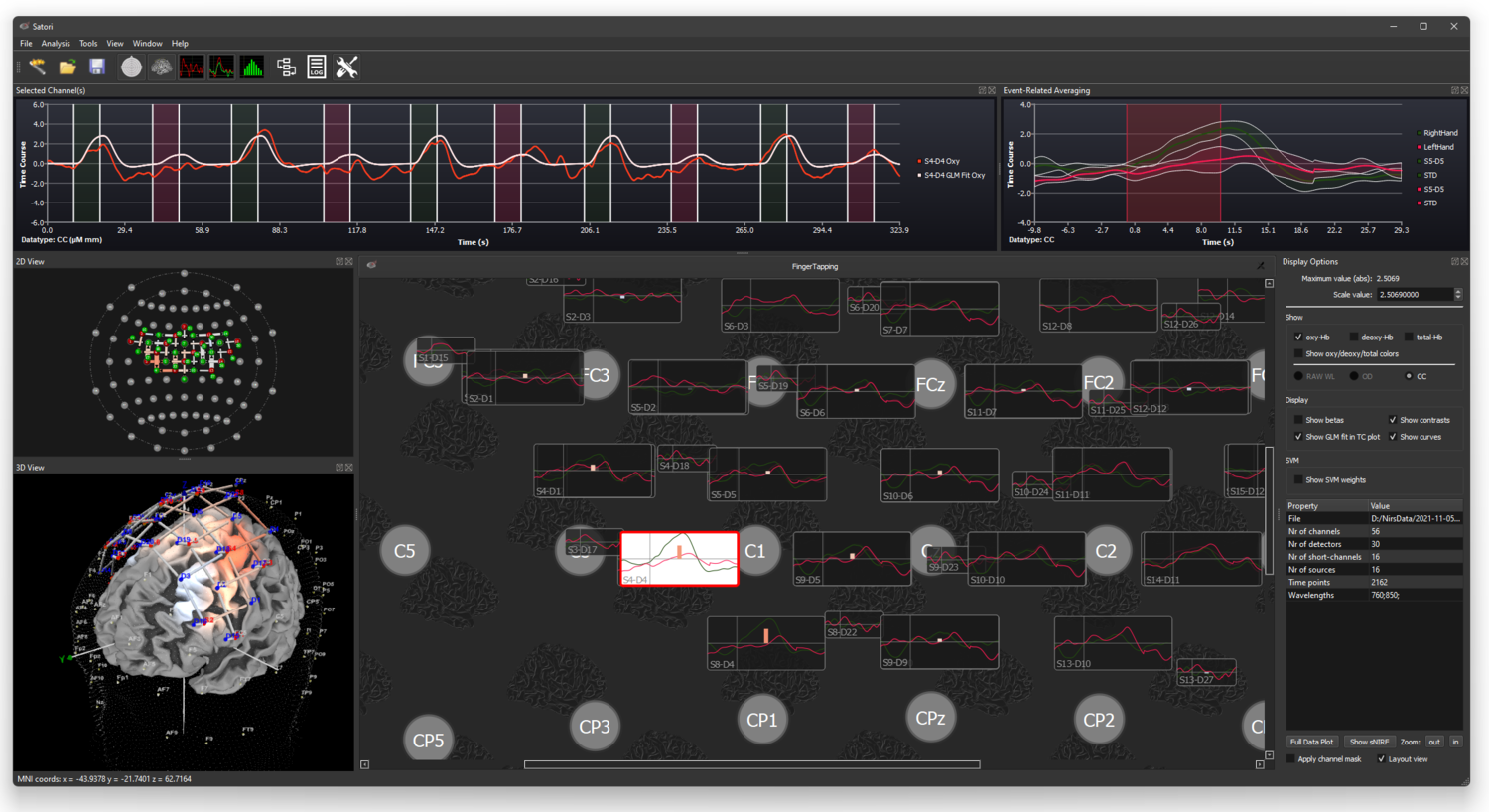
Having the possibility to inspect multiple views of the data at the same time allows for a much better orientation of the location of specific brain activity. In the example above, you can clearly see more activity on the left hemisphere induced by right-hand finger tapping.
Of course, the windows to inspect the data can be freely arranged and detached from the main window. This allows for a more detailed view as you can see below.

The time course of individual channels can be inspected for the different chromophores (Oxy, DeOxy and Total Hemoglobin). This includes the simultaneous view of event related averages and the whole channel time course. The versatility of Satori allows you to quickly review and understand the fNIRS data before deciding on the most suitable preprocessing and analysis method.
The launch of this first version promises continuous developments, support, and education to make fNIRS more accessible to researchers in the years to come. Stay tuned for future updates of Satori which will include direct access to Python, further developments for the Flow manager (a tool to organize and streamline your preprocessing and analysis).
We are looking forward to an exciting journey together with you!

Upcoming Webinars
Including a guest lecture by Dr. Ted Huppert
We are pleased to announce that we have three new webinars coming up! The first upcoming webinar will be a guest webinar by Dr. Ted Huppert (University of Pittsburgh). A week later the second webinar will focus on fNIRS functional connectivity analysis, and finally we will walk through the new Aurora fNIRS software. See below for more details, exact dates and registration links!

Upcoming Webinars
Co-registering fNIRS data & structural MRI data in MATLAB Brain AnalyzIR Toolbox (NIRS Toolbox) - March 28th 2019

We are honored to have Dr. Ted Huppert (University of Pittsburgh, developer of NIRS Toolbox) join us as guest speaker for a special NIRx webinar focusing on co-registering fNIRS data & structural MRI data in the Brain AnalyzIR Toolbox.
During the Webinar, Dr. Huppert will go over the import of anatomical (MRI) information, probe (montage) registration to anatomical landmarks (accounting for head size variations), optical forward model simulations, image reconstruction basics, and anatomically defined region-of-interest methods. If you are curious to learn more about the work of Dr. Huppert, visit his personal website http://huppertlab.net/, or view a recording of one of his lectures here: https://nirx.net/fnirs-analysis.
The Co-Registering fNIRS/MRI in NIRS Toolbox webinar is scheduled for:
March 28, 3PM CET, 10am EDT.
Studying functional connectivity with fNIRS - April 3rd 2019

How do different ares of the brain interact when the mind is at rest? Is there a causal effect between activation to a cognitive task in one area and simultaneous activity in another? Are there functional networks hidden behind our data?
For over a decade, functional connectivity has been receiving increased attention and curiosity of many neuroscientists. Several neuroimaging modalities can be applied to better understand functional networks, but the exquisite temporal resolution of fNIRS offers a perfect opportunity for a closer look at these networks.
In the “Studying functional connectivity with fNIRS” webinar, we will review concepts of functional connectivity and provide a simple demonstration of how to run a connectivity analysis with fNIRS data using the Brain AnalyzIR Toolbox.
The Studying functional connectivity with fNIRS webinar is scheduled for:
April 3, 4pm CET, 10am EDT.
Visit our online Support Center to register for this Webinar!
Overview of Aurora fNIRS
The brand-new Aurora fNIRS software package is intuitive, easy-to-use, and compatible with multiple operating systems. Developed to take a whole new approach to user instrument control and data acquisition, Aurora fNIRS introduces many new features as well as a fresh and elegant new look.

Among many added features, Aurora fNIRS comes with new optimized signal diagnostics to ensure that signal quality is optimal for every measurement. When data is recorded, the user has quick access to high-end whole-head 3d data visualization. And with the integrated LSL protocol, Aurora fNIRS is ready for real-time data analysis and multi-modal measurements.
Interested to learn all new advantages, and see how Aurora fNIRS differs from NIRStar?
The Overview of Aurora fNIRS webinar is scheduled for:
April 11, 4pm CET, 10am EDT.
Learn more about this webinar, as well as others, by visiting our Webinars page.

Turbo-Satori Webinar
Register now for the webinar
Neurofeedback, real-time data analysis and Brain Computer Interface (BCI) paradigms are becoming increasingly popular in fNIRS research. To facilitate the requests of many researchers, NIRx has partnered with Brain Innovation, whom have developed an advanced, real-time analysis software that allows for fast, result-driven high-quality fNIRS research: Turbo-Satori.

We would like to invite you to a Introduction to Turbo-Satori webinar, on February 28. During this webinar, Mr. Michael Lührs - head developer of Turbo-Satori, will give a walk-through of the software and discuss its advantages and possible applications.
Reserve your spot for the Webinar now, and sign-up below!
Introduction to Turbo-Satori, a real-time Analysis Program for fNIRS data
Date: 28.2.2019
Time: 4 pm CET, 10 am EDT

Interested to learn more about Turbo-Satori in advance? Have a look at its publication in Neurophotonics, or contact NIRx to discuss integrating Turbo-Satori with your current or desired fNIRS set-up!